ABA Therapy For Autism: A Complete Guide For Parents
When parents notice that their bachcha is facing difficulty in speaking, understanding, behaving, or following daily routines, it naturally creates worry.
You may see your child struggling with simple things like sitting for a few minutes, responding to their name, or expressing basic needs. Some children may get frustrated easily, while others may prefer to stay alone.
At this stage, many parents feel confused.
“What should I do next?”
“Is this normal?”
“Will my child improve?”
These questions are very common.
This is where ABA therapy for autism comes into the picture.
ABA therapy is one of the most widely used and trusted approaches to help children with autism learn important life skills.
It is not about forcing the child.
It is about understanding how your child learns and helping them step by step.
With the right guidance, ABA therapy can support communication, behaviour, learning, and daily routines in a very practical way.
What is ABA Therapy for Autism
ABA stands for Applied Behaviour Analysis.
But in simple words, ABA therapy for autism means helping a child learn useful behaviours and reduce behaviours that make daily life difficult.
It focuses on:
-
Teaching new skills
-
Improving communication
-
Building attention and focus
-
Reducing challenging behaviours
The process is very simple.
Skills are taught step by step.
Children are guided again and again.
And when they do something correctly, they are encouraged with praise or rewards.
For example:
If a child says a word correctly, they may get appreciation like “good job” or something they like.
This helps the child understand what behaviour is useful.
Over time, these small learnings build into bigger skills.
How ABA Therapy Works
Many parents feel that therapy may be complicated.
But ABA is actually very simple to understand.
Here is how it usually works:
-
Big skills are broken into small steps
-
One step is taught at a time
-
The child practices the step repeatedly
-
Correct responses are rewarded or appreciated
-
Progress is tracked regularly
Let’s take a simple example:
If the goal is to teach “asking for water”:
-
First, the child may learn to point
-
Then, to say a sound like “wa”
-
Then, slowly say “water”
Each step is taught dheere dheere.
There is no pressure.
Only guided learning.
What Skills ABA Therapy Can Help Improve
ABA therapy for autism focuses on real-life skills that matter for daily living.
Here are some important areas it helps with:
-
Communication (speaking, gestures, understanding words)
-
Eye contact and attention
-
Sitting tolerance
-
Following instructions
-
Toilet readiness
-
Play skills
-
Social interaction
-
Reducing problem behaviours
-
Daily living skills like eating, dressing
Here is a simple table for better clarity:
| Skill Area | How ABA Helps |
|---|---|
| Communication | Helps child express needs clearly |
| Attention | Improves sitting and focus |
| Behaviour | Reduces tantrums and frustration |
| Social Skills | Encourages interaction with others |
| Daily Routine | Builds habits like eating, sitting |
| Play Skills | Teaches meaningful play |
These are the skills that help children function better in everyday life.
Is ABA Therapy Good for Every Child
This is an important question.
The honest answer is:
Every child with autism is different.
ABA therapy can be very helpful for many children, but it should always be personalised.
Some children may need more focus on communication.
Some may need more behaviour support.
Some may need a mix of different therapies.
Good therapy always looks at:
-
Child’s age
-
Strengths
-
Challenges
-
Learning style
It is not a one-size-fits-all approach.
That is why proper assessment and planning are important.
When Should Parents Start ABA Therapy
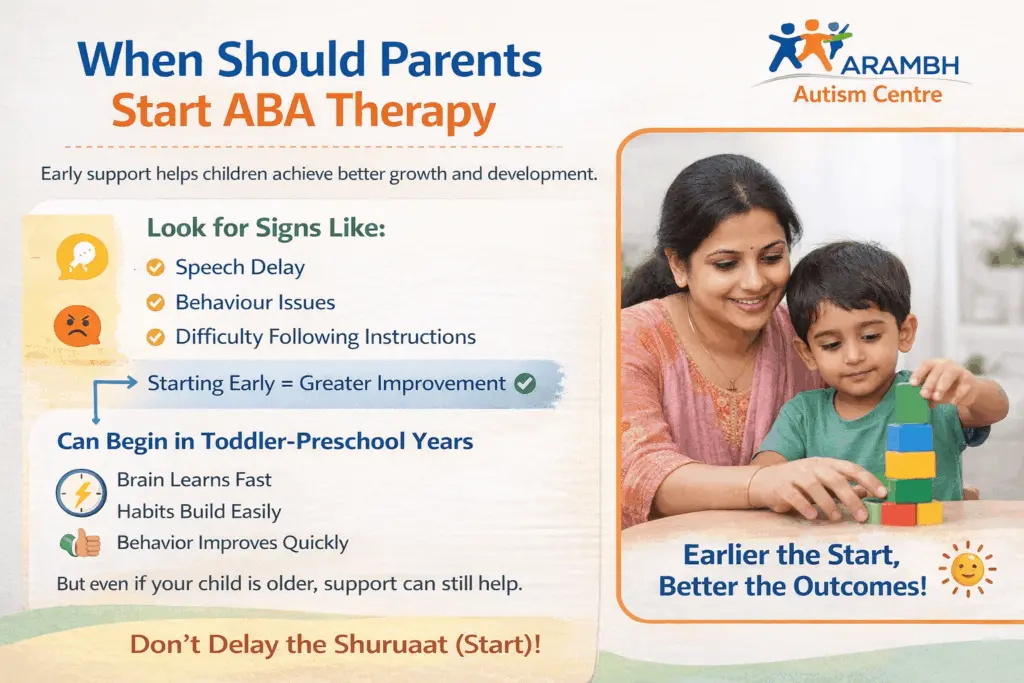
Many parents delay therapy because they are unsure.
But early support always helps more.
If you notice signs like:
-
Speech delay
-
Behaviour issues
-
Difficulty following instructions
Then it is better to start guidance early.
ABA therapy for children can begin in toddler or preschool years.
This is called early ABA intervention.
At this stage:
-
The brain is learning fast
-
Habits are easier to build
-
Behaviour patterns can improve more easily
But even if your child is older, support can still help.
The important thing is not to delay the shuruaat.
What Happens in an ABA Therapy Session
Parents often feel nervous about what happens in therapy.
Let’s simplify it.
A typical ABA session may include:
-
Goal-based teaching (specific skills are planned)
-
Play-based learning (using toys and activities)
-
Structured tasks (short and simple exercises)
-
Therapist-child interaction
-
Practice of communication and behaviour goals
-
Parent observation or feedback
Sessions are usually:
-
Interactive
-
Engaging
-
Designed according to the child’s level
It does not feel like strict classroom learning.
It feels like guided play with purpose.
Benefits of ABA Therapy for Parents and Families
ABA therapy is not only for the child.
It also helps families.
Parents learn:
-
How to handle behaviour calmly
-
How to communicate better with their child
-
How to build routines ghar par
-
How to support learning in daily life
This creates more confidence in parents.
Instead of feeling lost, they start feeling more in control.
Family life becomes more structured and manageable.
Common Misunderstandings About ABA Therapy
Many parents have concerns about ABA therapy.
Let’s clear some common misunderstandings:
“ABA forces the child”
Good ABA therapy does not force. It guides and supports.
“ABA ignores emotions”
Good therapy always respects the child’s comfort and emotions.
“ABA makes children robotic”
This is not true. Good ABA focuses on useful life skills, not unnatural behaviour.
“ABA is only about discipline”
ABA is about learning, not punishment.
It is important to choose the right centre where therapy is done with care and understanding.
How Parents Can Support ABA Therapy at Home
Parents play a big role in success.
Therapy sessions are limited.
But learning happens all day.
Here are simple ways to support your child:
-
Follow therapist’s guidance regularly
-
Practice small goals daily
-
Use praise when your child does something right
-
Stay patient
-
Keep routines simple
-
Notice small improvements
Here is a quick table for easy understanding:
| What Parents Can Do | Why It Helps |
|---|---|
| Repeat small tasks | Builds consistency |
| Use praise | Encourages learning |
| Stay calm | Reduces stress for child |
| Follow routine | Creates stability |
| Practice daily | Improves faster learning |
Parents ko perfect hone ki zarurat nahi hai.
Consistency matters more than perfection.
Challenges Families May Face During ABA Therapy
The journey is not always easy.
Some common challenges include:
-
Progress may feel slow
-
Parents may feel tired
-
Children may resist changes
-
Daily consistency can be difficult
-
Results take time
Sometimes parents feel:
“Nothing is improving.”
But in reality, progress is happening slowly.
It just needs time.
Results in autism therapy always come dheere dheere.
Why Families in Varanasi Trust Arambh Autism Centre
For families looking for autism therapy in Varanasi, Arambh Autism Centre has built strong trust over time.
It is known as one of the oldest, trusted, and recommended autism therapy centres in Varanasi.
Families choose Arambh because:
-
Therapy is structured and goal-based
-
Each child gets personalised planning
-
Parents are actively involved
-
The environment is supportive and understanding
-
The team is experienced and patient
The focus is not only on therapy.
It is on building confidence in both the child and the parents.
How Pooja Gupta’s Personal Journey Builds Parent Trust
At the heart of Arambh Autism Centre is Pooja Gupta.
She is not just a professional.
She is also the mother of an autistic child.
This brings real understanding.
She knows:
-
The emotional confusion parents feel
-
The daily struggles at home
-
The pressure from society
-
The fear about the future
Because of her journey, parents feel:
-
Understood
-
Supported
-
Guided with honesty
This human connection makes a big difference.
How to Know if Your Child May Benefit from ABA Therapy
Parents often wonder if their child needs ABA therapy.
Here are some signs to look for:
-
Difficulty following instructions
-
Frequent tantrums or behaviour issues
-
Speech or communication delay
-
Trouble sitting or focusing
-
Difficulty in daily routines
-
Limited play or interaction
If you notice multiple signs, it is better to seek guidance.
Do not try to self-diagnose everything.
A proper assessment helps in understanding the right support.
Final Message for Parents
ABA therapy for autism is not a quick fix.
It is a journey.
A journey that requires patience, consistency, and the right guidance.
But the good news is:
Children can learn.
Children can improve.
Children can build meaningful life skills.
With the right support system, progress happens step by step.
If you are in Varanasi, connecting with Arambh Autism Centre can be a helpful step in understanding your child and starting the right therapy journey.
You are not alone.
To understand this better, explore our ABA Therapy Service Page.
-
1. What is ABA therapy for autism in simple words?
It is a therapy that helps children learn useful behaviours and reduce difficult behaviours step by step.2. Is ABA therapy safe for children?
Yes, when done correctly, it is safe and focused on helping the child learn.3. How long does ABA therapy take?
It depends on the child. Progress takes time and consistency.4. Can parents support ABA therapy at home?
Yes, daily small efforts at home make a big difference.5. Does ABA therapy guarantee results?
No therapy guarantees results, but ABA can help improve important life skills over time.