Autism In Children: A Complete Parent Guide
When parents first notice that their bachcha is not developing like other children, it can feel confusing and scary.
Maybe your child is not speaking yet. Maybe they avoid eye contact. Maybe they prefer to stay alone instead of playing with others. At first, many parents feel unsure – “kya yeh normal hai ya kuch aur?”
This is where understanding autism in children becomes important.
This guide is written to help you understand autism in a calm and simple way. No complicated words. No fear. Just clear and practical information.
Autism does not mean something is “wrong” with your child. It means your child experiences the world differently.
With the right understanding and support, children can learn, grow, and improve in many areas of life.
What is Autism in Children
Autism in children is a developmental condition.
This means it affects how a child learns, communicates, behaves, and interacts with others.
A child with autism may:
-
Communicate differently
-
Respond differently to people
-
Show repeated behaviours
-
Learn in their own unique way
One important thing parents should remember:
Every child with autism is different.
Some children may speak well but struggle socially.
Some may have delayed speech but understand things better.
Some may need more support, while others may need less.
There is no single “type” of autism.
Common Signs of Autism in Children
Many parents ask, “What should I look for?”
Here are some common signs of autism in children:
-
Delayed speech or no speech
-
Limited or no eye contact
-
Not responding when name is called
-
Repetitive behaviours (like hand flapping, spinning)
-
Difficulty playing with other children
-
Prefers to stay alone
-
Unusual way of playing with toys
-
Strong reactions to sounds, lights, or touch
-
Difficulty adjusting to routine changes
Here is a simple table to understand better:
| Area | Signs Parents May Notice |
|---|---|
| Communication | Delay in speech, not using words meaningfully |
| Social | Avoiding eye contact, not interacting much |
| Behaviour | Repetitive actions, fixed habits |
| Play | Unusual or repetitive play patterns |
| Sensory | Over or under reaction to sound, touch, light |
Seeing one or two signs does not always mean autism.
But if multiple signs are present regularly, it is better not to ignore them.
Early Signs Parents May Notice at Home
Many early signs of autism are first noticed at home.
Parents may observe:
-
The child does not point to show interest
-
Does not copy actions like clapping or waving
-
Uses very few meaningful words
-
Prefers to play alone most of the time
-
Gets upset with loud sounds or touch
-
Repeats the same activity again and again
-
Does not follow simple instructions
For example:
You may call your child’s name multiple times, but they do not respond.
Or your child may play with a toy car by only spinning its wheels again and again.
These small observations are important.
At What Age Can Autism Be Noticed
Autism signs can appear at different ages.
Some children show early signs between 1.5 to 2 years.
In other children, signs may become more clear around 3 to 4 years.
There is no fixed age.
But if parents notice repeated delays or differences, it is better not to wait.
Early understanding always helps more than late realization.
What Causes Autism in Children
This is one of the most sensitive questions parents ask.
The truth is simple:
There is no single known cause of autism.
Autism is a neurodevelopmental condition, which means the brain develops differently.
It is not caused by:
-
Parenting style
-
Diet mistakes
-
Mobile use
-
Vaccines
-
Family actions
Parents should not blame themselves.
The focus should always be on understanding the child and starting the right support.
Is Autism a Disease or a Developmental Condition
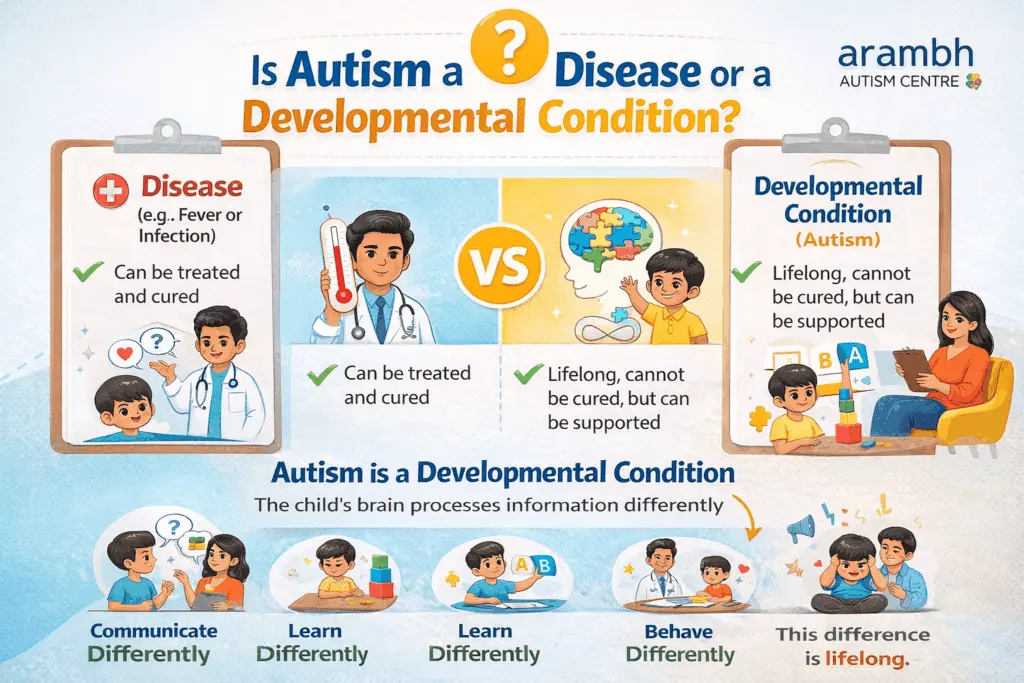
Autism is not a disease like fever or infection.
It is a developmental condition.
This means:
The child’s brain processes information in a different way.
Because of this, the child may:
-
Communicate differently
-
Learn differently
-
Behave differently
This difference is lifelong.
But with the right support, children can improve their skills and independence.
How Autism Can Affect Daily Life
Autism in children can affect daily life in different ways.
Here are some common challenges families may see:
-
Difficulty in communication
-
Behaviour issues like tantrums or frustration
-
Trouble interacting with others
-
Sensitivity to sound, light, or touch
-
Strong preference for routines
-
Difficulty learning new things
-
Challenges in self-care like eating or dressing
For example:
A child may get very upset if a daily routine changes.
Or may struggle to express needs, leading to crying or frustration.
Understanding these behaviours helps parents respond better.
Every Child with Autism is Different
No two children with autism are exactly the same.
This is very important to understand.
| Child Type | What You May See |
|---|---|
| Child A | Speaks well but struggles socially |
| Child B | Limited speech but understands instructions |
| Child C | Active but has behaviour challenges |
| Child D | Quiet but struggles with communication |
Some children may:
-
Speak fluently
-
Need help in communication
-
Have mild difficulties
-
Need more structured support
Comparison does not help.
Understanding your own child does.
When Parents Should Seek Professional Help
Parents should consider seeking guidance if:
-
Speech is delayed
-
Child does not respond to name
-
Eye contact is very limited
-
Behaviour seems repetitive
-
Social interaction is difficult
If these signs are repeated, it is better to consult a professional.
You do not need to wait for things to get worse.
Early action always helps.
How Autism is Usually Identified
Autism is usually understood through:
-
Observing the child’s behaviour
-
Understanding developmental history
-
Listening to parent concerns
-
Professional assessment
There is no single test.
It is a combination of observations and understanding.
The goal is not to label the child.
The goal is to understand how to support the child better.
What Therapies May Help Children with Autism
There are different types of autism therapy for children.
Each therapy helps in a different area.
| Therapy | What It Helps With |
|---|---|
| Speech Therapy | Communication and language |
| Behaviour Therapy | Behaviour and learning habits |
| Occupational Therapy | Daily activities and motor skills |
| Social Skills Training | Interaction with others |
| Parent Training | Helping parents support child |
| Online Therapy | Remote guidance and sessions |
These therapies work together as a complete support system.
Why Early Intervention Matters
Early support can make a big difference.
When therapy starts early:
-
Children learn communication faster
-
Behaviour improves
-
Daily routines become easier
-
Learning skills develop better
Progress happens dheere dheere.
But early shuruaat makes the journey smoother.
Role of Parents in Autism Support
Parents play a very important role.
Therapy alone is not enough.
What parents do at home matters a lot.
Simple actions include:
-
Talking during daily routines
-
Encouraging interaction
-
Following therapist guidance
-
Staying consistent
Parents ko perfect hone ki zarurat nahi hai.
Consistency is more important than perfection.
Common Myths About Autism in Children
There are many misunderstandings about autism.
Let’s clear some of them:
-
Autism is caused by bad parenting – False
-
All autistic children are the same – False
-
Therapy does not help – False
-
Speech delay always means autism – False
-
Autism can be fixed quickly – False
Understanding the truth helps parents make better decisions.
Challenges Parents Often Face Emotionally
Parents go through many emotions:
-
Confusion
-
Fear
-
Guilt
-
Social pressure
-
Family opinions
-
Worry about the future
These feelings are normal.
You are not alone.
Many parents go through the same journey.
Why Families in Varanasi Trust Arambh Autism Centre
For families looking for an autism centre in Varanasi, Arambh Autism Centre is a trusted name.
It is known as one of the oldest, trusted, and recommended centres in the city.
Families trust Arambh because:
-
Therapies are structured and practical
-
Guidance is clear and simple
-
The environment is caring and supportive
-
Parents receive step-by-step help
-
Focus is on real-life development
How Pooja Gupta’s Personal Journey Builds Parent Trust
One of the strongest trust factors at Arambh Autism Centre is Pooja Gupta.
She is not only the founder.
She is also a mother of an autistic child.
This gives her deep understanding of:
-
Emotional struggles
-
Daily challenges
-
Social pressure
-
Real-life parenting situations
Because of this, parents feel understood.
Not judged.
And that makes a big difference.
What Parents Can Do Today if They Notice Signs
If you notice signs of autism, here are simple steps:
-
Observe your child carefully
-
Note repeated behaviours
-
Do not ignore delays
-
Consult a professional
-
Start therapy if needed
-
Learn how to support your child daily
-
Stay patient and consistent
Small steps lead to big changes.
Can Children with Autism Improve with the Right Support
Yes, children can improve with the right support.
Every child is different.
But many children:
-
Improve communication
-
Learn better behaviours
-
Become more independent
-
Build confidence
Improvement takes time.
But it is possible.
Final Message for Parents
Autism does not mean the end of hope.
It means a different journey.
With the right understanding, early support, and a strong support system, children can grow and learn meaningful life skills.
The journey may feel difficult in the beginning.
But with the right guidance, things become clearer.
If you are in Varanasi, connecting with Arambh Autism Centre can be a helpful step towards supporting your child in the right way.
You can learn more in detail on our Early Intervention Service Page.
-
1. What are the first signs of autism in children?
Delayed speech, low eye contact, and not responding to name are common early signs.2. At what age can autism be detected?
Signs may appear from 1.5 to 3 years, but can vary.3. Can autism improve with therapy?
Yes, with proper support, children can improve in many areas.4. Is autism caused by parenting?
No, autism is not caused by parenting.5. What should parents do first?
Observe, note concerns, and consult a professional early.