Early Intervention for Autism: A Complete Parent Guide
When a parent first starts noticing that their bachcha is not developing like other children of the same age, it can feel confusing, worrying, and sometimes even overwhelming.
At first, these differences may look small. Maybe your child is not speaking yet. Maybe they don’t respond when called. Maybe they prefer to play alone. Many parents ignore these signs in the beginning, hoping things will improve on their own.
Some families say, “abhi chhota hai, baad mein bolne lagega.”
But deep inside, parents still feel something is different.
This is where early intervention for autism becomes very important.
Early intervention is not about fear. It is about understanding your child better and giving the right support at the right time.
The truth is simple – when children get early support, they can learn important skills more easily. These skills include communication, behaviour, attention, and daily life routines.
And most importantly, early support gives parents clarity and direction.
If you are here, reading this, you have already taken the most important step – awareness.
What is Early Intervention in Autism
Early intervention for autism means starting support as soon as you notice signs of developmental delay or autism in your child.
You do not need to wait for a final diagnosis to begin.
If something feels different, support can begin.
In very simple words, early intervention means helping your child learn basic life skills at the right time.
This support may include:
-
Speech therapy – helping your child communicate
-
Behaviour therapy – teaching useful habits and reducing difficult behaviours
-
Social skill support – helping your child interact with others
-
Parent guidance – helping parents to understand what to do at home
-
Daily routine training – building habits like sitting, eating, listening
It is important to understand one thing clearly.
Early intervention is not about changing your child.
It is about helping your child understand the world better in a way that suits them.
Why Early Intervention Matters
The early years of a child’s life are the most powerful learning years.
During this time, the brain is developing very fast.
Children are naturally learning – how to speak, how to respond, how to understand emotions, how to interact.
If the right support is given during this stage, learning becomes easier.
If support is delayed, learning can become more difficult later.
Early intervention for autism helps children build:
-
Better communication skills
-
Eye contact and attention
-
Listening and understanding
-
Behaviour control
-
Daily routine habits
-
Basic learning skills
But one important thing to remember is – this process always happens dheere dheere.
There is no pressure.
There is no forcing.
Just guided learning step by step.
Common Early Signs of Autism Parents Should Notice
Many parents are not sure what signs are important.
Here is a simple table to help you understand early signs in a clear way:
| Area | What You May Notice |
|---|---|
| Speech | Not speaking, delayed speech, repeating words |
| Eye Contact | Avoiding eye contact or very limited eye contact |
| Response | Not responding when name is called |
| Behaviour | Repetitive actions like hand flapping or spinning |
| Social Interaction | Prefers to play alone, difficulty mixing with others |
| Play Style | Uses toys in unusual ways (like only spinning wheels) |
| Sensory | Overreaction or no reaction to sound, light, touch |
| Understanding | Difficulty following simple instructions |
It is important not to panic after seeing one sign.
But if multiple signs are present, it is better to take action early.
Waiting does not help. Early support does.
At What Age Should Parents Start Intervention
One of the biggest doubts parents have is:
“Is my child too young for therapy?”
The answer is – No.
If you notice delays, you should not wait.
Early intervention for autism can start as early as 1.5 to 2 years of age.
In fact, toddler and preschool years are the best time to start.
At this age:
-
The brain is learning fast
-
Habits are forming
-
Behaviour patterns are flexible
Starting early does not harm your child.
It helps your child.
Even if you are unsure, it is always better to consult and understand rather than delay.
Types of Therapies Included in Early Intervention for Autism
Early intervention for autism includes different types of therapies.
Each therapy focuses on helping your child in a specific area.
Here is a simple table for better understanding:
| Therapy Type | What It Helps With | Simple Explanation |
|---|---|---|
| Speech Therapy | Communication | Helps child speak, understand words, use gestures |
| Behaviour Therapy (ABA) | Behaviour & learning | Teaches good habits and reduces problem behaviour |
| Occupational Therapy | Daily skills | Helps with eating, holding objects, writing |
| Sensory Therapy | Comfort with surroundings | Helps manage sound, touch, light sensitivity |
| Parent Training | Home support | Teaches parents what to do ghar par |
| Play-Based Therapy | Learning through play | Uses games to teach skills naturally |
These therapies are not separate.
They work together to support the child completely.
How Early Intervention Helps in Real Life
Parents often want practical answers.
“What will actually change?”
Here are some real-life improvements that early autism therapy can bring:
-
Your child starts asking for things instead of crying
-
Sitting tolerance improves
-
Child starts understanding simple instructions
-
Behaviour becomes more manageable
-
Communication improves – even small words or gestures
-
Child becomes more independent in daily tasks
For example:
A child who earlier cried for water may start pointing or saying “paani”.
A child who did not sit even for 1 minute may start sitting for 5-10 minutes.
These small improvements are big milestones.
The Role of Parents in Early Intervention
Parents are the most important part of the therapy journey.
Therapy sessions happen for limited time.
But learning continues the whole day.
That is why what happens ghar par matters the most.
Simple things parents can do:
-
Talk to your child during daily routines
-
Encourage eye contact
-
Repeat simple words
-
Follow the therapist’s guidance regularly
-
Stay consistent
Parents ko expert hone ki zarurat nahi hai.
You just need guidance and patience.
When parents and therapists work together, results improve faster.
Can Autism Improve with Early Intervention
This is a sensitive but important topic.
Autism does not have a “cure”.
But children can improve a lot with early intervention.
With the right support:
-
Communication improves
-
Behaviour becomes better
-
Learning ability increases
-
Confidence grows
-
Independence improves
Every child is different.
Some children show faster improvement.
Some take more time.
But improvement is always possible.
The goal is not to make the child “perfect”.
The goal is to help the child live a better, more comfortable life.
How Early Intervention Supports Child Development Long Term
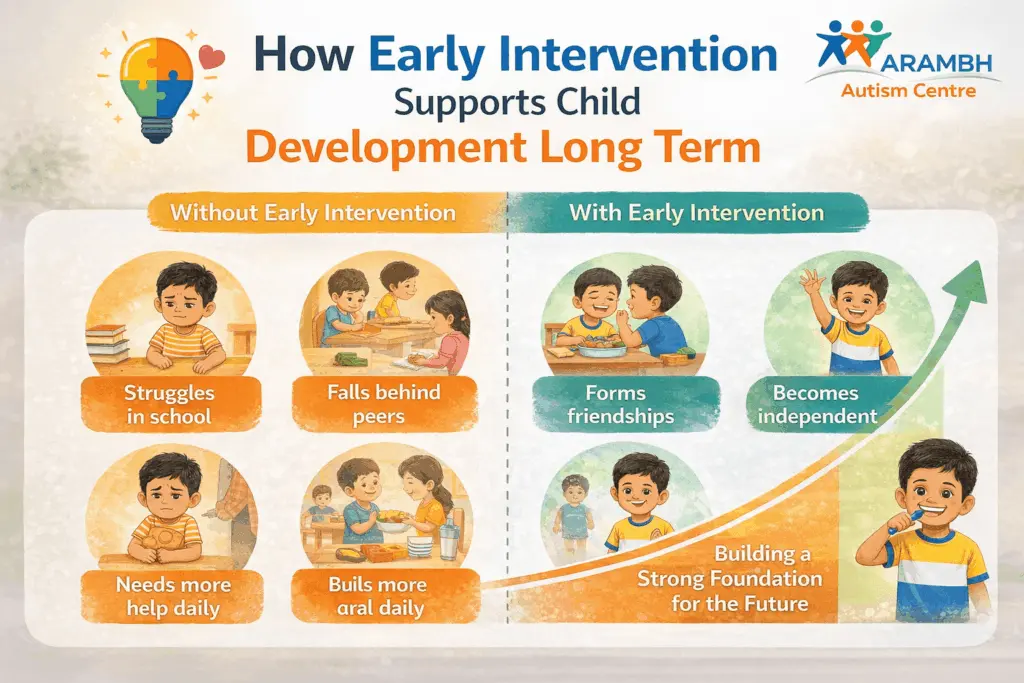
Early intervention for autism is not only about short-term improvement.
It also builds a strong foundation for the future.
Children who receive early support often:
-
Adjust better in school environments
-
Learn classroom behaviour like sitting, listening, and following rules
-
Develop basic academic readiness
-
Improve social understanding with peers
-
Become more independent in daily life
For example:
A child who learns early communication can later:
-
Express needs clearly in school
-
Build friendships slowly
-
Participate in group activities
Without early support, these areas can become more challenging later.
That is why early intervention is not just help for today.
It is an investment in your child’s future.
Challenges Parents Face in the Beginning
The beginning phase is often emotionally heavy.
Parents go through many thoughts at the same time.
Some common challenges include:
-
Confusion about what is happening
-
Fear of accepting the situation
-
Pressure from family or relatives
-
Comparing with other children
-
Not knowing which therapy is right
-
Searching for a trusted centre
-
Emotional stress and overthinking
Many parents also feel guilt.
They wonder if they did something wrong.
It is important to understand – this is not your fault.
What matters is what you do next.
Taking action is more important than overthinking.
Why Families in Varanasi Trust Arambh Autism Centre
For parents looking for reliable autism support in Varanasi, Arambh Autism Centre has become a trusted choice.
It is known as one of the oldest, trusted, and recommended autism therapy centres in Varanasi.
Families feel comfortable here because:
-
Guidance is simple and practical
-
Therapies are structured and goal-based
-
The environment is calm and supportive
-
Children are treated with patience and care
-
Parents are guided at every step
The centre focuses not just on the child, but also on supporting the family.
Because when families understand, progress becomes stronger.
How Pooja Gupta’s Journey Helps Parents Feel Understood
One of the strongest pillars of trust at Arambh Autism Centre is Pooja Gupta.
She is not just the founder.
She is also the mother of an autistic child.
This changes everything.
She understands:
-
The emotional struggles parents face
-
The confusion in the early stage
-
The social pressure from relatives
-
The daily challenges at home
This is not theoretical understanding.
This is real-life experience.
Because of this, parents feel:
-
Heard
-
Understood
-
Supported
And this emotional connection builds trust.
What Parents Can Do Today if They Notice Signs
If you are noticing early signs, here are simple steps you can take today:
-
Observe your child carefully
-
Note down behaviours that concern you
-
Do not ignore repeated signs
-
Speak to a professional
-
Start early support if recommended
-
Learn how to support your child daily
You do not need to do everything at once.
Just take the first step.
That first step is the most powerful.
Final Reassurance for Parents
The journey may feel difficult in the beginning.
But things become clearer with the right shuruaat.
Progress happens dheere dheere.
Every small step matters.
With the right support system, guidance, and consistency, your child can learn important life skills over time.
You are not alone.
If you are in Varanasi, reaching out to Arambh Autism Centre can be a meaningful step towards understanding and supporting your child better.
If you are feeling confused ya worried, our Early Intervention Service Page can help you understand better.
-
1. What is early intervention autism in simple words?
It means starting therapy and support early when a child shows developmental delays.2. Is early intervention really helpful?
Yes, it helps children improve communication, behaviour, and daily life skills.3. Can I start therapy without diagnosis?
Yes, if delays are visible, support can begin without waiting.4. How long does therapy take?
It depends on the child. Progress happens step by step.5. Can parents help at home?
Yes, daily small efforts at home make a big difference.