Occupational Therapy Complete Autism Guide for Parents
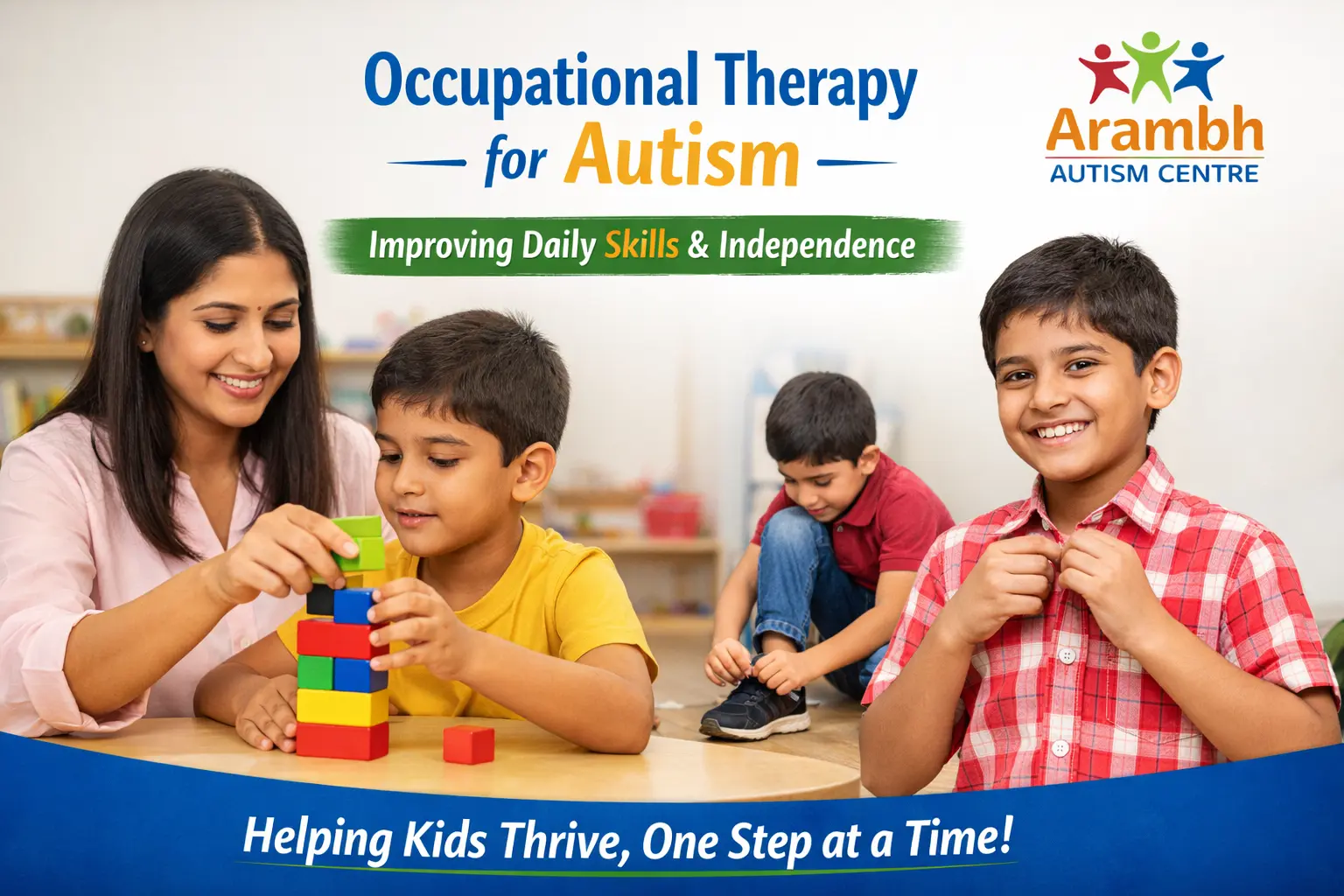
When parents first notice that their bachcha is struggling with simple daily activities, it can feel confusing.
You may see things like:
-
Difficulty sitting properly
-
Trouble holding a spoon or pencil
-
Problems with eating or dressing
-
Constant movement or restlessness
-
Strong reactions to sounds, touch, or clothes
At first, many parents think this is just a phase.
But when these challenges continue, it becomes important to samajhna what your child actually needs.
This is where occupational therapy for autism plays an important role.
Occupational therapy helps children learn everyday skills.
These are not big academic skills.
These are basic life skills – like eating, sitting, playing, dressing, and using hands properly.
With the right support, children can slowly become more comfortable, confident, and independent in daily life.
What is Occupational Therapy for Autism
Occupational therapy for autism is a type of support that helps children learn daily life skills.
In simple words, it helps children do everyday activities more easily.
These activities include:
-
Eating on their own
-
Holding objects properly
-
Sitting and focusing
-
Playing with others
-
Getting dressed
-
Using hands for small tasks
It is not only about physical movement.
Autism occupational therapy also helps with:
-
Attention and focus
-
Body control
-
Sensory understanding
-
Hand coordination
-
Independence
The goal is simple – to help your child manage daily life better.
Why Children with Autism May Need Occupational Therapy
Every child is different.
Some children with autism may find daily tasks more challenging than others.
This does not mean something is wrong.
It just means they need the right support.
Some common challenges include:
-
Difficulty sitting for activities
-
Trouble holding crayons or pencils
-
Problems with feeding or chewing
-
Weak hand strength
-
Sensory sensitivities (too sensitive or not sensitive enough)
-
Poor balance or coordination
-
Difficulty following routines
These challenges can affect daily life.
Occupational therapy autism helps children manage these difficulties step by step.
Signs a Child May Benefit from Occupational Therapy
Here are some signs parents often notice:
-
Avoids certain clothes or textures
-
Gets upset with loud sounds
-
Difficulty eating with a spoon
-
Trouble holding small objects
-
Struggles with dressing like buttoning
-
Cannot sit for even a short time
-
Falls often or has poor balance
-
Gets frustrated during simple tasks
Here is a simple table to help you understand:
| Area | What Parents May Notice |
|---|---|
| Eating | Difficulty using spoon, picky eating |
| Dressing | Trouble wearing clothes, avoiding certain fabrics |
| Sitting | Cannot sit in one place for long |
| Hand Skills | Weak grip, difficulty holding crayons |
| Sensory | Overreaction to sound, touch, light |
| Movement | Poor balance, frequent falling |
| Behaviour | Frustration during simple tasks |
If you notice multiple signs, it is helpful to consider OT for autism.
How Occupational Therapy Helps Children with Autism
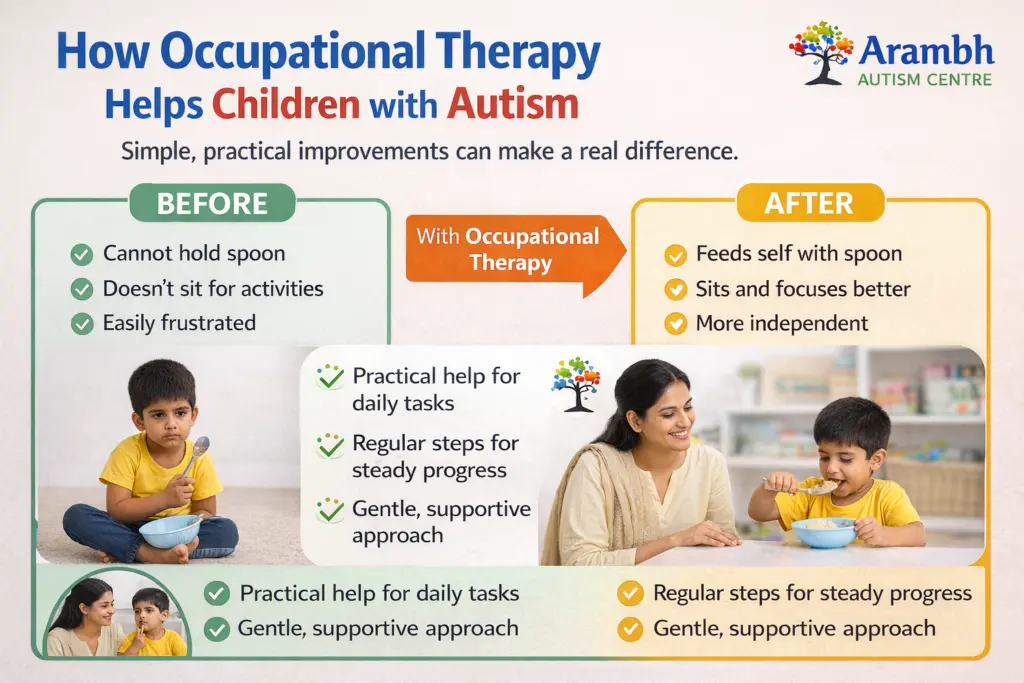
Occupational therapy focuses on real-life improvements.
Not theory. Not complex methods.
Just practical help.
With regular therapy, children may show improvements like:
-
Better sitting and attention
-
Improved hand use
-
More independence in eating and dressing
-
Better coordination
-
Improved play skills
-
Less frustration
-
Better adjustment to daily routines
For example:
A child who cannot hold a spoon may slowly start self-feeding.
A child who avoids sitting may begin sitting for small activities.
These changes happen dheere dheere.
But they make a big difference in daily life.
What Happens in an Occupational Therapy Session
Many parents feel unsure about what actually happens in therapy.
Here is a simple idea.
An occupational therapy session usually includes:
-
Play-based activities
-
Hand exercises (like picking small objects)
-
Sensory activities (like different textures or movements)
-
Balance exercises
-
Coordination games
-
Self-care training (like eating or dressing)
-
Attention-building tasks
-
Parent guidance
The session is not strict or stressful.
It is designed to be child-friendly.
Children learn through play and structured activities.
What are Sensory Issues in Autism
Many children with autism have sensory issues.
This means their body reacts differently to things around them.
Some children may be too sensitive.
Some may not feel enough.
For example:
-
Loud sounds may feel painful
-
Certain clothes may feel uncomfortable
-
Some children avoid touch
-
Some children keep jumping or moving
Here is a simple table:
| Sensory Type | Example |
|---|---|
| Sound | Covers ears with noise |
| Touch | Avoids certain fabrics |
| Movement | Constant jumping or spinning |
| Food | Rejects certain textures |
| Light | Sensitive to bright lights |
This is not bad behaviour.
This is how their body processes information.
Occupational therapy helps manage this.
Occupational Therapy and Sensory Regulation
Sensory regulation means helping the child feel calm and balanced.
OT for autism helps children:
-
Stay calmer
-
Focus better
-
Handle daily routines
-
Manage transitions (like moving from play to study)
-
Feel more comfortable in different environments
This is done using structured activities that match the child’s needs.
No forcing.
Just a gradual adjustment.
Occupational Therapy for Fine Motor Skills
Fine motor skills are small hand movements.
These are very important for daily life.
Examples include:
-
Holding a crayon
-
Turning pages
-
Using a spoon
-
Picking small objects
-
Buttoning clothes
Some children struggle with these.
Occupational therapy helps improve these step by step.
For example:
First, the child learns to hold objects.
Then, to control hand movement.
Then, to use tools like crayons.
It is a gradual process.
Occupational Therapy for Daily Living Skills
Daily living skills are the most important part of independence.
These include:
-
Eating properly
-
Dressing independently
-
Brushing teeth
-
Sitting for meals
-
Following simple routines
Occupational therapy focuses strongly on these.
Because these skills matter the most in real life.
Parents often feel happy when:
-
Child starts eating on their own
-
Child sits calmly during meals
-
Child participates in daily routines
These are big achievements.
Is Occupational Therapy Only for Severe Cases
Many parents think OT is only for severe cases.
This is not true.
Occupational therapy for autism can help children with:
-
Mild challenges
-
Moderate challenges
-
Sensory difficulties
-
Hand coordination issues
-
Daily routine struggles
Even small difficulties can affect daily life.
Early support can prevent bigger challenges later.
Role of Parents in Occupational Therapy Progress
Parents play a very important role.
Therapy alone is not enough.
What happens ghar par matters a lot.
Children learn through repetition.
So daily practice helps.
Parents ko perfect hone ki zarurat nahi hai.
You just need:
-
Guidance
-
Patience
-
Consistency
When parents follow therapy strategies at home, progress improves faster.
How Parents Can Support Occupational Therapy at Home
Here are some simple things parents can do:
-
Encourage self-feeding
-
Let the child try dressing
-
Practice simple hand activities
-
Build daily routines
-
Reduce unnecessary pressure
-
Follow therapist guidance
-
Appreciate small progress
Do not rush.
Do not compare.
Just support your child step by step.
Challenges Parents May Face in the Beginning
The beginning phase is not easy.
Parents may feel:
-
Confused about behaviour
-
Unsure why the child avoids tasks
-
Worried about slow progress
-
Pressured by relatives
-
Comparing with other children
-
Tired of repeating the same things
This is normal.
Progress takes time.
It happens dheere dheere.
Consistency is more important than speed.
Why Families in Varanasi Trust Arambh Autism Centre
For families looking for occupational therapy in Varanasi, Arambh Autism Centre is a trusted choice.
It is known as one of the oldest, trusted, and recommended autism therapy centres in Varanasi.
Families trust Arambh because:
-
Therapy is practical and child-focused
-
Programs are structured
-
Parents receive clear guidance
-
The environment is supportive
-
Focus is on real-life skills
The centre understands that each child is different.
So support is planned accordingly.
How Pooja Gupta’s Journey Helps Families Feel Understood
One of the strongest reasons parents feel comfortable at Arambh is Pooja Gupta.
She is not only the founder.
She is also the mother of an autistic child.
This makes her understanding real, not theoretical.
She knows:
-
Emotional struggles
-
Daily challenges
-
Family pressure
-
Practical difficulties
Because she has lived this journey.
Parents feel safe sharing their concerns.
They feel understood.
And that trust matters a lot.
When Parents Should Start Occupational Therapy
If you notice difficulties in:
-
Daily tasks
-
Sensory behaviour
-
Hand coordination
-
Sitting or attention
Do not wait.
The right shuruaat at the right time helps children build skills faster.
Early support is always better than delayed support.
Can Occupational Therapy Help a Child Become More Independent
Every child is different.
There are no guarantees.
But with the right support system, occupational therapy can help children:
-
Improve daily skills
-
Become more confident
-
Participate better in routines
-
Gain independence step by step
Independence does not come suddenly.
It builds slowly with practice and support.
Final Message for Parents
Daily life skills are built step by step.
Small improvements matter a lot.
Holding a spoon, sitting calmly, wearing clothes – these are big achievements.
With the right therapy, guidance, and patience, children can become more comfortable and independent.
You are not alone in this journey.
If you are in Varanasi, connecting with Arambh Autism Centre can be a meaningful step towards helping your child grow with the right support system.
To see how this works in real therapy, check our OT Therapy Service Page.
-
1. What is occupational therapy for autism?
It helps children learn daily life skills like eating, sitting, and playing.2. When should I start occupational therapy?
As early as possible when delays are noticed.3. Is OT necessary for all autistic children?
Not all, but many children benefit from it.4. How long does therapy take?
It depends on the child and consistency.5. Can I help my child at home?
Yes, daily practice at home supports therapy progress.