Parenting a Child With Autism: Emotional Guide

Parenting a child with autism is a journey filled with many emotions at the same time.
Love, worry, confusion, hope, fear, guilt, and sometimes even loneliness – all of these feelings can exist together in one parent’s heart.
When you first notice something different about your bachcha, or when you hear the word “autism” for the first time, it can feel overwhelming.
You may not know what to think. You may not know what to do next.
And most importantly, you may feel like no one truly understands what you are going through.
This guide is written for you.
Not just to give information, but to support you emotionally and practically.
Because parenting a child with autism is not just about therapy or treatment.
It is also about understanding your own emotions, finding strength, and building a path forward – dheere dheere.
The Emotional Reality of Parenting a Child With Autism
In the beginning, most parents go through a mix of emotions.
You may feel:
-
Shock after hearing or noticing signs
-
Confusion about what is happening
-
Denial – hoping it is just a phase
-
Fear about your child’s future
-
Guilt – questioning yourself again and again
-
Sadness that things are not as expected
-
Anger or frustration in difficult moments
-
Loneliness because others may not understand
-
Constant worry about what lies ahead
These feelings are natural.
You are not overreacting.
You are not weak.
You are a parent trying to understand a situation that is new, unexpected, and emotionally heavy.
It is Not Your Fault
This is one of the most important things every parent needs to hear.
Autism is not caused by bad parenting.
It is not because you did something wrong.
It is not because you didn’t give enough time, attention, or love.
Many parents carry silent guilt.
They keep asking:
“Did I miss something?”
“Did I make a mistake?”
The answer is no.
You did not cause this.
Letting go of guilt is not easy, but it is necessary.
Because your energy is needed for supporting your child, not blaming yourself.
Why Many Parents Feel Lost in the Beginning
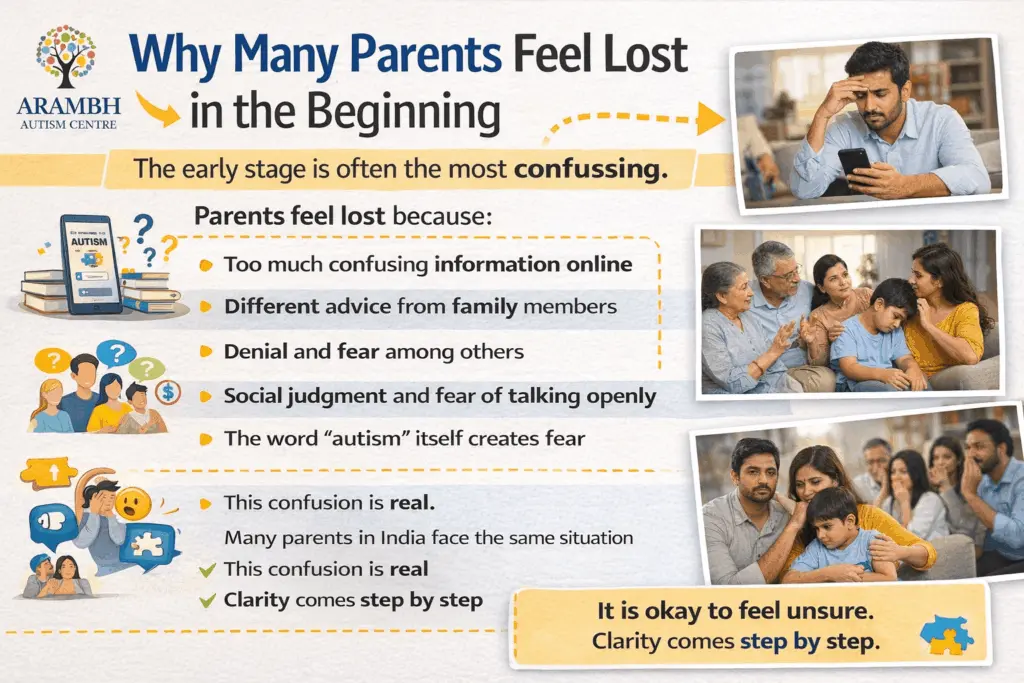
The early stage is often the most confusing.
Parents feel lost because:
-
There is too much information online, and much of it is confusing
-
Family members give different advice
-
Some people deny the situation, while others create fear
-
Social judgment makes parents hesitate to talk openly
-
The word “autism” itself creates fear
-
There is no clear starting point
This confusion is real.
Many parents in India face the same situation.
It is okay to feel unsure.
Clarity comes step by step.
Accepting the Journey Takes Time
Acceptance does not happen in one day.
And it should not be forced.
Some days you may feel strong.
Some days you may feel emotional again.
That is normal.
You are learning, adjusting, and slowly understanding your child’s world.
This process happens dheere dheere.
Give yourself time.
Healing is not a straight line.
Common Daily Challenges Parents Face
Parenting a child with autism brings real-life challenges every day.
Some common struggles include:
-
Communication difficulties – child not expressing needs clearly
-
Behaviour challenges – crying, frustration, or sudden reactions
-
Sleep issues – irregular sleep patterns
-
Food struggles – limited food choices or sensitivity
-
Sensory issues – discomfort with sound, light, or touch
-
Difficulty during outings – public places becoming stressful
-
School-related concerns – adjustment, learning pace
-
Repeating routines every day without break
These are not small challenges.
They require patience, energy, and emotional strength.
And it is okay to feel tired sometimes.
The Hidden Mental Load on Mothers and Fathers
Parenting a child with autism affects both mothers and fathers.
Sometimes differently, but deeply.
Mothers may feel:
-
Constant responsibility
-
Emotional exhaustion
-
Pressure to manage everything
Fathers may feel:
-
Silent stress
-
Financial pressure
-
Difficulty expressing emotions
Both parents carry a mental load.
Thinking about therapy, future, schooling, behaviour, and daily needs – all the time.
Even when nothing is said, a lot is felt.
This silent burden is real.
Family Pressure and Social Judgment in India
In Indian families, parenting is not just personal – it is social.
Many parents face:
-
Blame from relatives
-
Unwanted advice like “yeh theek ho jayega”
-
Comparisons with other children
-
Pressure to “fix” the child quickly
-
Misunderstanding about autism
-
Embarrassment during public situations
This adds another layer of stress.
Parents often feel judged instead of supported.
It is important to remember:
Not everyone will understand your journey.
And that is okay.
Your focus should remain on your child, not on society’s opinions.
How Parents Can Stay Emotionally Strong
Staying emotionally strong does not mean never feeling weak.
It means continuing even on difficult days.
Some practical ways to support yourself:
-
Take one day at a time
-
Stop comparing your child with others
-
Celebrate small progress
-
Accept that some days will be hard
-
Ask for help when needed
-
Focus on what your child can learn
Strength does not come from perfection.
It comes from consistency.
Why Parents Also Need Support
When people think about autism, they focus on the child.
But parents also need support.
You need:
-
Correct information
-
Emotional reassurance
-
Practical guidance
-
A safe space to ask questions
Without support, parents feel lost.
With the right guidance, parents feel stronger.
And when parents are stronger, children benefit more.
That is why autism parenting support is equally important.
The Role of Hope Without False Expectations
Hope is important.
But it should be realistic.
Every child is different.
Some children progress faster.
Some take more time.
There are no shortcuts.
There are no miracles.
But there is progress.
With early guidance, therapy, and consistency, children can improve in communication, behaviour, and daily life.
Hope should guide you – not pressure you.
How to Build a Better Routine at Home
A structured routine helps both the child and the parents.
Here is a simple table to guide you:
| Area | What You Can Do |
|---|---|
| Daily Routine | Keep fixed times for waking, eating, playing, sleeping |
| Communication | Use simple and repeated words |
| Behaviour | Stay calm and consistent in responses |
| Activities | Include small structured play and learning time |
| Instructions | Give short and clear instructions |
| Breaks | Allow rest time when the child feels overwhelmed |
A predictable routine reduces confusion and improves learning.
How Parents Can Bond Better With Their Child
Connection is more important than perfection.
Simple ways to build bonding:
-
Follow your child’s interests
-
Play together regularly
-
Celebrate small responses
-
Use simple communication
-
Be emotionally present
-
Create small happy moments daily
Even small interactions build strong emotional connection.
What to Do When You Feel Emotionally Tired
There will be days when you feel exhausted.
This is normal.
You can:
-
Take small breaks
-
Share responsibility when possible
-
Talk to someone you trust
-
Stop blaming yourself
-
Focus on one step at a time
-
Seek guidance when needed
You are not alone.
Many parents feel this way.
And it is okay to pause.
Parenting as a Team: Mother, Father, and Family Support
When both parents work together, things become easier.
Consistency matters.
If both parents follow similar routines and approaches, the child learns better.
But not every family has full support.
That is also a reality.
In such cases, even one strong and consistent caregiver can make a big difference.
Siblings and Autism in the Family
If there are siblings, they also need attention and understanding.
Parents can:
-
Spend one-on-one time with them
-
Explain things in simple ways
-
Encourage bonding
-
Maintain emotional balance
A supportive family environment helps everyone.
Why Early Guidance Helps Parents Emotionally Too
Early guidance is not just for the child.
It helps parents feel less confused.
When you understand what is happening and what to do next, your stress reduces.
The right shuruaat gives direction.
And direction reduces fear.
Why Families in Varanasi Trust Arambh Autism Centre
For families in Varanasi, Arambh Autism Centre has become a trusted name.
It is known as one of the oldest, trusted, and recommended autism therapy centres in Varanasi.
Parents trust Arambh because:
-
Guidance is clear and practical
-
Therapy is structured and child-focused
-
Parents are supported, not ignored
-
The environment is calm and understanding
-
Families feel heard and respected
It is not just a therapy centre.
It is a place where families feel supported.
How Pooja Gupta’s Personal Journey Helps Parents Feel Understood
At the heart of Arambh Autism Centre is Pooja Gupta.
She is not only the founder.
She is also a mother of an autistic child.
This makes her understanding different.
She knows:
-
The confusion in the beginning
-
The emotional pain parents feel
-
The pressure from society
-
The daily struggles at home
-
The small victories that bring joy
This is real experience.
Not just professional knowledge.
That is why parents feel understood.
What Parents Can Do Today to Feel More in Control
Here are simple steps you can take:
-
Learn about your child calmly
-
Write down your concerns
-
Seek proper guidance
-
Start therapy support if needed
-
Create a simple routine ghar par
-
Stop comparing progress
-
Focus on one improvement at a time
-
Build your own support system
Small steps bring clarity.
You Do Not Have to Be a Perfect Parent
You do not need to be perfect.
You just need to be present.
Your child does not need perfection.
Your child needs:
-
Love
-
Patience
-
Consistency
-
Understanding
Mistakes will happen.
Difficult days will come.
That is part of parenting.
What matters is that you keep trying.
Final Message for Parents
Parenting a child with autism is not an easy journey.
But you are not alone.
With the right guidance, emotional support, patience, and consistency, things can become more manageable.
Progress may feel slow.
But it happens dheere dheere.
If you are in Varanasi, connecting with Arambh Autism Centre can help you find direction, support, and understanding.
You and your child both deserve support.
And this journey, though challenging, can also become meaningful with the right help.
You can learn more in detail on our CBT Therapy Service Page.
-
1. How do parents feel after autism diagnosis?
Parents may feel confused, scared, guilty, or overwhelmed. These feelings are normal.2. Is it normal to feel stressed while parenting an autistic child?
Yes, it is completely normal. Parenting challenges can be emotionally demanding.3. How can parents stay strong emotionally?
By taking one day at a time, seeking support, and focusing on small progress.4. Do parents also need therapy or guidance?
Yes, emotional and practical support helps parents manage better.5. Can family support make a difference?
Yes, a supportive family environment helps both the child and parents.