Social Skills Complete Autism Therapy Guide for Parents
Many parents first notice autism not just through speech delay, but through social differences.
You may see that your bachcha prefers to play alone. Maybe they don’t take turns. Maybe they don’t respond when other children try to talk or play. Sometimes, they may not understand simple social things like sharing, waiting, or greeting others.
For parents, this can be confusing.
You may wonder – “Will my child be able to make friends?”
This is where social skills autism therapy becomes very helpful.
Social skills training is a type of support that helps children learn how to connect, communicate, and interact more comfortably with others.
It is not about forcing your child to behave like others.
It is about helping your child understand social situations in a simple and comfortable way.
With the right support, children can slowly build confidence in social interaction.
What is Social Skills Training for Autism
Social skills training for autism is a structured way of teaching children how to interact with people in daily life.
For many children, these skills do not come naturally. So they are taught step by step.
These skills include:
-
Making eye contact (when comfortable)
-
Taking turns during play
-
Greeting others like saying hello
-
Sharing toys or objects
-
Waiting patiently
-
Understanding simple emotions like happy, sad, angry
-
Playing with other children
-
Starting or responding in conversation
In simple words, social skills autism therapy teaches your child how to connect with people in everyday situations.
It is done in a supportive and child-friendly way.
Why Children with Autism May Need Social Skills Support
Every child is different.
Children with autism are not “wrong” – they just understand social situations differently.
Some common challenges include:
-
Preferring to play alone
-
Difficulty understanding facial expressions
-
Trouble taking turns
-
Not knowing how to join other children in play
-
Limited back-and-forth conversation
-
Difficulty making or keeping friendships
-
Feeling uncomfortable in group situations
These challenges are not because the child does not want to connect.
It is because they may not know how to connect.
With the right guidance, these skills can be developed dheere dheere.
Signs a Child May Benefit from Social Skills Therapy
Parents often observe certain behaviours that indicate the need for support.
Here is a simple table to help you understand:
| Situation | What Parents May Notice |
|---|---|
| Playing | Child prefers to play alone most of the time |
| Sharing | Difficulty sharing toys or objects |
| Turn-taking | Does not wait for their turn |
| Interaction | Limited response when others try to talk |
| Emotions | Difficulty understanding feelings of others |
| Social Conflicts | Frequent misunderstandings with other children |
| Behaviour | Gets frustrated in group situations |
| Play Style | Repetitive or isolated play patterns |
If you notice multiple signs, social skills therapy can be helpful.
How Social Skills Therapy Helps Children with Autism
Parents want real-life improvements, not just theory.
Here is how social skills autism therapy helps in daily life:
-
Child starts interacting more with others
-
Better turn-taking during games
-
Improved understanding of basic emotions
-
Increased confidence in group settings
-
Better communication with family and classmates
-
Improved play skills
-
Reduced frustration during social situations
For example:
A child who earlier ignored others may start responding.
A child who did not wait may start waiting for a few seconds.
These small steps build over time.
What Happens in a Social Skills Training Session
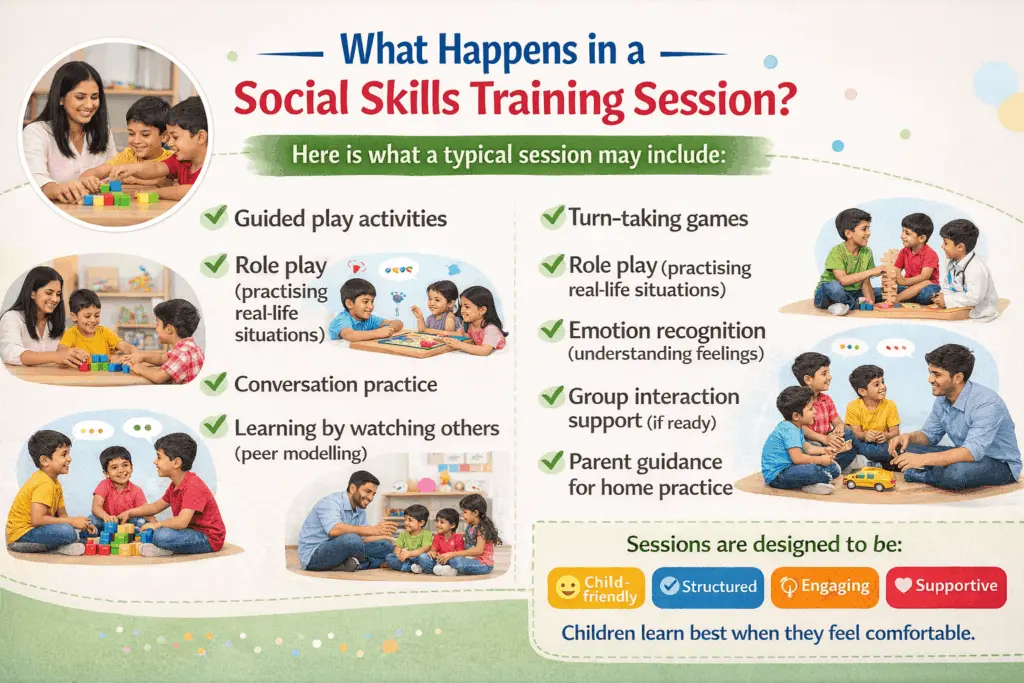
Many parents are unsure what happens in therapy.
Here is what a typical session may include:
-
Guided play activities
-
Turn-taking games
-
Role play (practising real-life situations)
-
Emotion recognition (understanding feelings)
-
Conversation practice
-
Group interaction support (if ready)
-
Learning by watching others (peer modelling)
-
Parent guidance for home practice
Sessions are designed to be:
-
Child-friendly
-
Structured
-
Engaging
-
Supportive
Children learn best when they feel comfortable.
Social Skills and Communication: How They Work Together
Social skills and communication are closely connected.
A child may know words, but still struggle socially.
For example:
-
Speaking but not responding properly
-
Talking but not taking turns
-
Saying words but not understanding context
That is why therapy focuses on:
-
Listening
-
Waiting
-
Responding
-
Joining interaction
This makes communication more meaningful.
It becomes easier for parents ko to understand their child’s progress.
Social Skills Training for Making Friends
Friendship is not taught in one day.
It is built step by step.
Social skills autism therapy helps children learn basics like:
-
Greeting others
-
Joining play
-
Sharing interest
-
Waiting for their turn
-
Understanding simple game rules
-
Responding when someone talks
-
Showing interest in others
These are small but important steps.
Over time, they help children feel more comfortable around others.
Group Social Skills Activities for Children with Autism
Group activities can be helpful for many children.
They provide real-life practice.
Benefits include:
-
Practising with other children
-
Learning by watching others
-
Improving flexibility
-
Building confidence
-
Understanding group behaviour
However, not every child is ready for group sessions immediately.
Some children first need one-to-one support.
After that, they can slowly move to group activities.
Can Social Skills Be Taught Step by Step
Yes, many social skills can be taught.
But they are not taught all at once.
They are taught dheere dheere through:
-
Repetition
-
Practice
-
Guidance
-
Daily use
Every child learns at a different pace.
Some may take more time.
That is completely okay.
The focus is on progress, not perfection.
Role of Parents in Social Skills Development
Parents play a very important role.
Social learning does not happen only in therapy sessions.
It happens throughout the day.
Small daily moments matter.
For example:
-
Saying hello to family members
-
Taking turns while playing
-
Asking simple questions
-
Practising waiting
These everyday actions build social understanding.
Parents are not expected to be perfect.
They just need the right direction.
How Parents Can Support Social Skills at Home
Here are some practical ways parents can help ghar par:
-
Play turn-taking games like passing a ball
-
Model greetings like hello and bye
-
Encourage simple conversations
-
Teach waiting during daily routines
-
Practise sharing calmly
-
Use simple emotion words like happy, sad
-
Create small play opportunities with siblings or cousins
-
Appreciate small social efforts
Consistency is more important than perfection.
Challenges Parents May Face in the Beginning
This journey is not always easy.
Parents often face challenges like:
-
Child prefers to stay alone
-
Slow improvement in social response
-
Difficulty in school or playground
-
Comparing with other children
-
Family pressure
-
Worry about future friendships
These feelings are natural.
Social growth takes time.
Progress happens dheere dheere.
Why Families in Varanasi Trust Arambh Autism Centre
For families looking for autism therapy in Varanasi, Arambh Autism Centre is a trusted choice.
It is known as one of the oldest, trusted, and recommended centres in Varanasi.
Parents choose Arambh because:
-
Therapy is structured and practical
-
Children receive personalised support
-
Parents get clear guidance
-
Environment is caring and understanding
-
Focus is on real-life development
The centre supports both the child and the family.
How Pooja Gupta’s Journey Helps Families Feel Understood
One of the strongest reasons families trust Arambh Autism Centre is Pooja Gupta.
She is not only the founder.
She is also a mother of an autistic child.
This gives her a deep understanding of:
-
Emotional struggles
-
Confusion in the beginning
-
Social pressure
-
Daily parenting challenges
This is real experience, not just professional knowledge.
Parents feel safe, understood, and supported.
When Parents Should Start Social Skills Training
If you notice social difficulties, it is better to start early.
You do not need to wait.
The right shuruaat can make a big difference.
Early support helps children:
-
Build confidence
-
Learn interaction skills
-
Feel more comfortable socially
Starting early always helps.
Can Children with Autism Build Friendships with Support
This is an important question.
The honest answer is:
Every child is different.
But with the right support system, many children can improve their social interaction.
They may:
-
Respond better to others
-
Participate in simple play
-
Build comfort around peers
-
Develop basic friendship skills
The goal is not perfect friendships.
The goal is meaningful connection.
Final Message for Parents
Social skills take time to develop.
Even in typical children, friendship is learned slowly.
For children with autism, it just needs more guidance.
With the right support, patience, and consistency, children can learn to connect in their own way.
Every small step matters.
You are not alone in this journey.
If you are in Varanasi, connecting with Arambh Autism Centre can be a helpful step toward building your child’s social confidence.
To know how this helps your bachcha, visit our Social Skills Training Service Page.
-
1. What is social skills autism therapy?
It helps children learn how to interact, communicate, and connect with others.2. Can autistic children learn to make friends?
Yes, with support and practice, many children improve their social interaction.3. When should I start social skills training?
As soon as you notice social difficulties.4. Can I help my child at home?
Yes, simple daily activities can support social learning.5. Is group therapy necessary?
Not always. Some children start with one-to-one support first.