Speech Therapy Complete Autism Guide for Parents
One of the biggest worries for parents is when their bachcha is not speaking like other children.
You may notice things like:
-
Your child is not speaking at all
-
Speaking very few words
-
Repeating the same words again and again
-
Not asking for things clearly
-
Getting frustrated when trying to communicate
These situations can feel confusing and stressful.
Many parents keep waiting, hoping that speech will come with time. Some people may say, “thoda late bol raha hai, theek ho jayega.”
But deep inside, parents feel the need to understand what is happening.
This is where speech therapy autism becomes important.
Speech therapy is not just about teaching a child to speak. It is about helping the child communicate better in daily life – expressing needs, understanding others, and connecting with people.
With the right support, children can slowly learn how to communicate in ways that work for them.
What is Speech Therapy for Autism
Speech therapy for autism is a type of support that helps children improve communication skills.
But communication does not always mean speaking full sentences.
It can include:
-
Sounds
-
Words
-
Gestures (like pointing)
-
Facial expressions
-
Pictures
-
Simple interactions
Speech therapy helps children:
-
Understand what others are saying
-
Express what they want
-
Improve attention and listening
-
Learn how to interact with others
For example:
A child who cannot say “water” may learn to point, use a sound, or use a picture.
That is also communication.
So speech therapy for autism is not only about talking more. It is about communicating better.
Why Communication Challenges Happen in Autism
Many autistic children experience difficulty with communication.
This does not mean they cannot learn.
It means they may process language differently.
Some common challenges include:
-
Delayed speech development
-
Limited use of words
-
Repeating words without understanding (echolalia)
-
Difficulty asking for needs
-
Not responding consistently when called
-
Trouble understanding instructions
-
Difficulty using language in social situations
For example:
A child may repeat “TV chalao” again and again, but not use it meaningfully to ask.
Or a child may understand some words but not respond.
These challenges are common in autism.
The good news is – with the right communication therapy for autism, children can improve step by step.
Signs a Child May Need Speech Therapy
Parents often wonder when to seek help.
Here are some practical signs that your child may need speech therapy:
-
Not speaking as expected for age
-
Using very few words
-
Not asking for needs clearly
-
Not responding to name consistently
-
Repeating the same phrases without purpose
-
Difficulty following simple instructions
-
Getting frustrated when unable to communicate
-
Limited use of speech during play or interaction
If you notice multiple signs, it is better to take action early.
Early support is always more helpful than waiting.
How Speech Therapy Helps Children with Autism
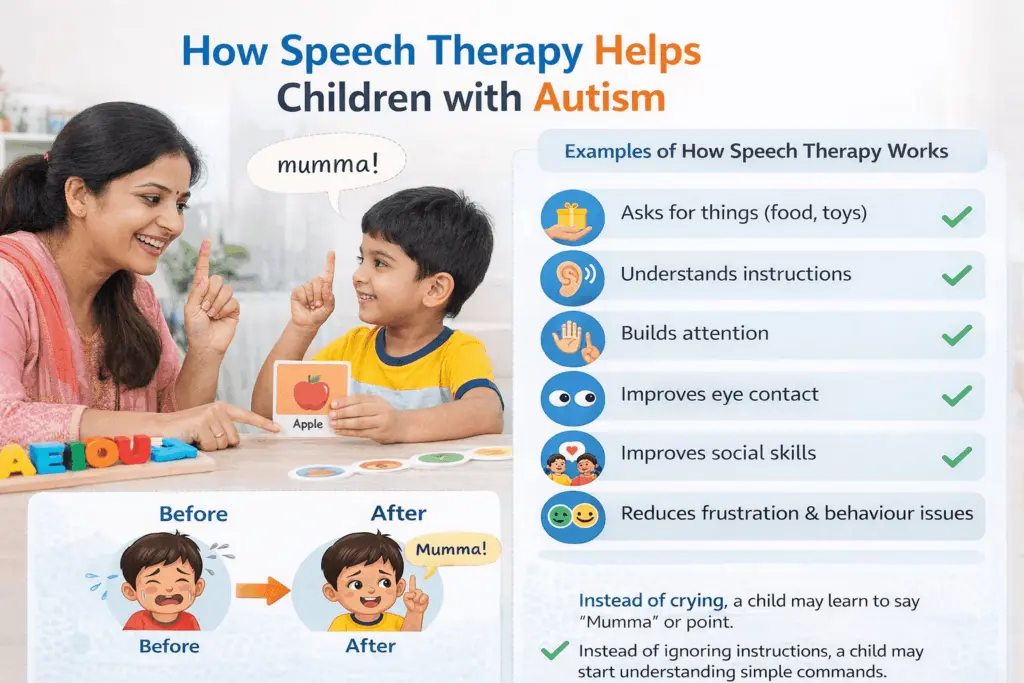
Speech therapy autism focuses on real-life communication.
It is not only about learning words.
It is about helping your child function better in daily situations.
Here is how speech therapy helps:
-
Helps child ask for things (like food, toys, water)
-
Improves understanding of instructions
-
Builds attention during communication
-
Encourages eye contact during interaction
-
Teaches meaningful use of words or sounds
-
Improves social communication skills
-
Reduces frustration and behaviour issues
For example:
Instead of crying, a child may learn to say “mumma” or point.
Instead of ignoring instructions, a child may start understanding simple commands.
These changes make daily life easier for both child and parents.
What Happens in a Speech Therapy Session
Many parents feel unsure about what happens during therapy.
Speech therapy sessions are not strict or stressful.
They are designed to be child-friendly and engaging.
Here is what usually happens:
-
Play-based activities to keep the child interested
-
Practice of sounds, words, or gestures
-
Use of pictures for communication
-
Turn-taking games to build interaction
-
Activities to improve attention and listening
-
Simple exercises for communication development
-
Guidance for parents on what to do at home
The goal is to make learning natural and comfortable.
Children learn best when they enjoy the process.
Is Speech Therapy Only for Nonverbal Children
This is a common misunderstanding.
Speech therapy is not only for children who do not speak.
It is also helpful for children who:
-
Speak but do not use words meaningfully
-
Have limited vocabulary
-
Cannot form sentences properly
-
Do not understand instructions well
-
Struggle with conversation
-
Have difficulty in social communication
For example:
A child may speak many words but still not be able to express needs clearly.
Such children also benefit from speech therapy.
So speech therapy autism supports both verbal and nonverbal children.
Speech Therapy Goals for Children with Autism
Speech therapy focuses on practical and achievable goals.
Here is a simple table to help parents understand these goals:
| Goal Area | What It Means in Simple Words |
|---|---|
| Attention | Child starts focusing during communication |
| Requesting | Child learns to ask for needs |
| Vocabulary | Learning new words step by step |
| Understanding | Following simple instructions |
| Sentence Use | Combining words into small sentences |
| Social Skills | Talking or interacting with others |
| Expression | Sharing needs, feelings, or choices |
These goals are not rushed.
They are built dheere dheere.
Every child progresses at their own pace.
Role of Parents in Speech Therapy Progress
Parents play a very important role in communication development.
Therapy sessions happen for a limited time.
But learning continues throughout the day.
That is why what happens ghar par matters a lot.
Children learn communication best in daily life situations like:
-
Eating
-
Playing
-
Getting ready
-
Watching something
-
Asking for help
Parents ko perfect hone ki zarurat nahi hai.
You just need guidance and consistency.
When parents follow therapist’s advice regularly, progress becomes stronger.
How Parents Can Support Speech Therapy at Home
Here are simple and practical ways parents can support speech therapy:
| What Parents Can Do | How It Helps |
|---|---|
| Talk simply | Helps child understand better |
| Repeat words | Builds familiarity with language |
| Encourage asking | Promotes communication |
| Use routines | Daily life becomes learning opportunity |
| Give time to respond | Helps child process language |
| Celebrate small efforts | Builds confidence |
| Follow therapist plan | Keeps learning consistent |
For example:
If your child wants water, wait and encourage them to say or show something instead of giving immediately.
These small steps create big progress over time.
Challenges Parents May Face in the Beginning
The beginning stage can feel difficult.
Many parents go through:
-
Worry when the child is not speaking
-
Comparing with other children
-
Family pressure or advice
-
Confusion about therapy
-
Feeling that progress is too slow
It is important to remember:
Progress in speech therapy for autism happens dheere dheere.
Every child is different.
Some children take more time.
Some show quicker improvement.
There is no fixed timeline.
Why Families in Varanasi Trust Arambh Autism Centre
For parents looking for speech therapy in Varanasi, Arambh Autism Centre is a trusted choice.
It is known as one of the oldest, trusted, and recommended autism therapy centres in Varanasi.
Families trust Arambh because:
-
Therapies are structured and practical
-
Support is tailored to each child
-
Parents receive clear guidance
-
The environment is calm and understanding
-
Focus is on real-life skill development
The centre believes in building a strong support system for both child and parents.
How Pooja Gupta’s Journey Helps Families Feel Understood
At the heart of Arambh Autism Centre is Pooja Gupta.
She is not only the founder.
She is also a mother of an autistic child.
This gives her a deep understanding of:
-
Emotional struggles parents face
-
Confusion in the beginning
-
Daily challenges at home
-
Social pressure from others
Her journey helps families feel:
-
Understood
-
Supported
-
Guided with real experience
This connection builds trust that goes beyond therapy.
When Parents Should Start Speech Therapy
Many parents wait too long.
They hope speech will develop on its own.
But if communication delays are visible, it is better not to wait.
Early shuruaat of speech therapy for autism can help:
-
Build communication skills faster
-
Reduce frustration
-
Improve learning ability
Even if you are unsure, it is okay to consult a professional.
Taking early action is always better.
Can Children with Autism Improve Communication with Therapy
This is an important question.
The honest answer is:
Yes, many children improve communication with speech therapy.
But improvement depends on:
-
The child’s needs
-
Consistency of therapy
-
Parent involvement
-
Overall support system
Children may:
-
Learn to speak words
-
Use gestures or pictures
-
Understand instructions better
-
Express needs more clearly
-
Interact more with others
The goal is not perfection.
The goal is progress.
Final Message for Parents
If your child is struggling with communication, you are not alone.
Many parents go through the same journey.
Speech therapy for autism is not a quick fix.
It is a process.
A journey.
Progress happens step by step.
With patience, the right guidance, and a strong support system, your child can learn better ways to communicate.
If you are in Varanasi, reaching out to Arambh Autism Centre can be a helpful step towards understanding your child’s communication needs and starting the right support.
If you want to go deeper, read our Speech Therapy Service Page.
-
1. What is speech therapy autism?
It is therapy that helps children improve communication, including speaking, understanding, and expressing needs.2. When should I start speech therapy for my child?
If you notice speech delay or communication difficulty, you should start early.3. Can a child speak after speech therapy?
Many children improve communication, but progress depends on each child.4. Is speech therapy only for nonverbal children?
No, it helps both nonverbal and verbal children.5. Can I help my child at home?
Yes, daily simple communication practice at home is very important.