
Parents often arrive at ArambH holding two different opinions from two different relatives: one is certain it is just ADHD and he will grow out of it, another is convinced it is autism. The truth is that autism and ADHD can look remarkably similar on the surface, overlap in real children more often than people expect, and still need very different support plans. Here is how to start telling them apart.
Why the Confusion Is So Common
Both conditions can involve a child who does not sit still in class, does not follow instructions the first time, interrupts conversations, or has meltdowns that look like tantrums from the outside. A teacher or relative watching for five minutes might reasonably guess either one. The difference becomes clearer once you look at what is actually driving the behaviour, not just the behaviour itself.
What Autism Looks Like at Its Core
Autism is fundamentally a difference in social communication and in how the brain processes the world. Core features include difficulty reading social cues like tone and facial expression, a preference for sameness and routine, intense or narrow interests, and sensory responses that can be much stronger or much weaker than typical - certain sounds, textures, or lights that feel unbearable or barely noticeable.
What ADHD Looks Like at Its Core
ADHD is fundamentally about regulating attention and impulse. A child with ADHD usually wants to connect socially and often reads social cues reasonably well, but struggles to sit still, wait their turn, or filter out distractions long enough to finish a task. The difficulty is in the control systems of the brain, not in understanding people.
Where They Genuinely Overlap
This is the part that trips up even experienced teachers. Both can look inattentive in a classroom. Both can struggle with sudden transitions. Both can have meltdowns when overwhelmed. Both can show sensory sensitivities, though this is more central to autism. And importantly, the two are not mutually exclusive - a significant number of autistic children also meet the criteria for ADHD, and a careful assessment will consider both rather than forcing a single label.
Key Differences Worth Watching For
- Social reciprocity. A child with ADHD usually wants friends and tries to join play, even if impulsively. A child with autism may genuinely prefer solitary play or struggle to understand what joining play even involves.
- Play patterns. ADHD play tends to be energetic but conventional - cars, games, rough play. Autistic play often includes lining up objects, repeating the same scenario, or an intense focus on one specific topic.
- Language development. Autistic children more often show unusual language patterns early on - repeating phrases (echolalia), delayed speech, or very literal understanding. ADHD rarely affects early language development itself.
- Response to routine change. A child with ADHD might get excited or distracted by a changed routine. A child with autism is more likely to become distressed by it.
- Eye contact and nonverbal communication. Reduced or unusual eye contact, pointing, and gesture use in early childhood lean toward autism rather than ADHD.
Why Getting the Right Picture Matters
The two conditions respond best to different strategies. Autism-focused support tends to centre on predictability, visual supports, communication tools, and sensory-informed environments. ADHD-focused support tends to centre on executive function strategies, behavioural structuring, and sometimes medical management alongside therapy. A child with both needs a plan that genuinely blends the two, which is why guessing from a checklist online is rarely enough.
What To Do If You Are Not Sure
Please do not rely on a single conversation, a relative's opinion, or an online quiz to settle this. A proper multidisciplinary assessment, combining structured observation, parent interview, and standardised tools, is the only reliable way to tell the two apart or confirm both are present. At ArambH, our assessments are usually completed within two visits and give you a written picture you can act on with confidence.
Not sure which one you are seeing in your child?
Book a free 30-minute consultation. We will talk through what you are noticing and recommend the right next step, with no obligation.
Book Free Consultation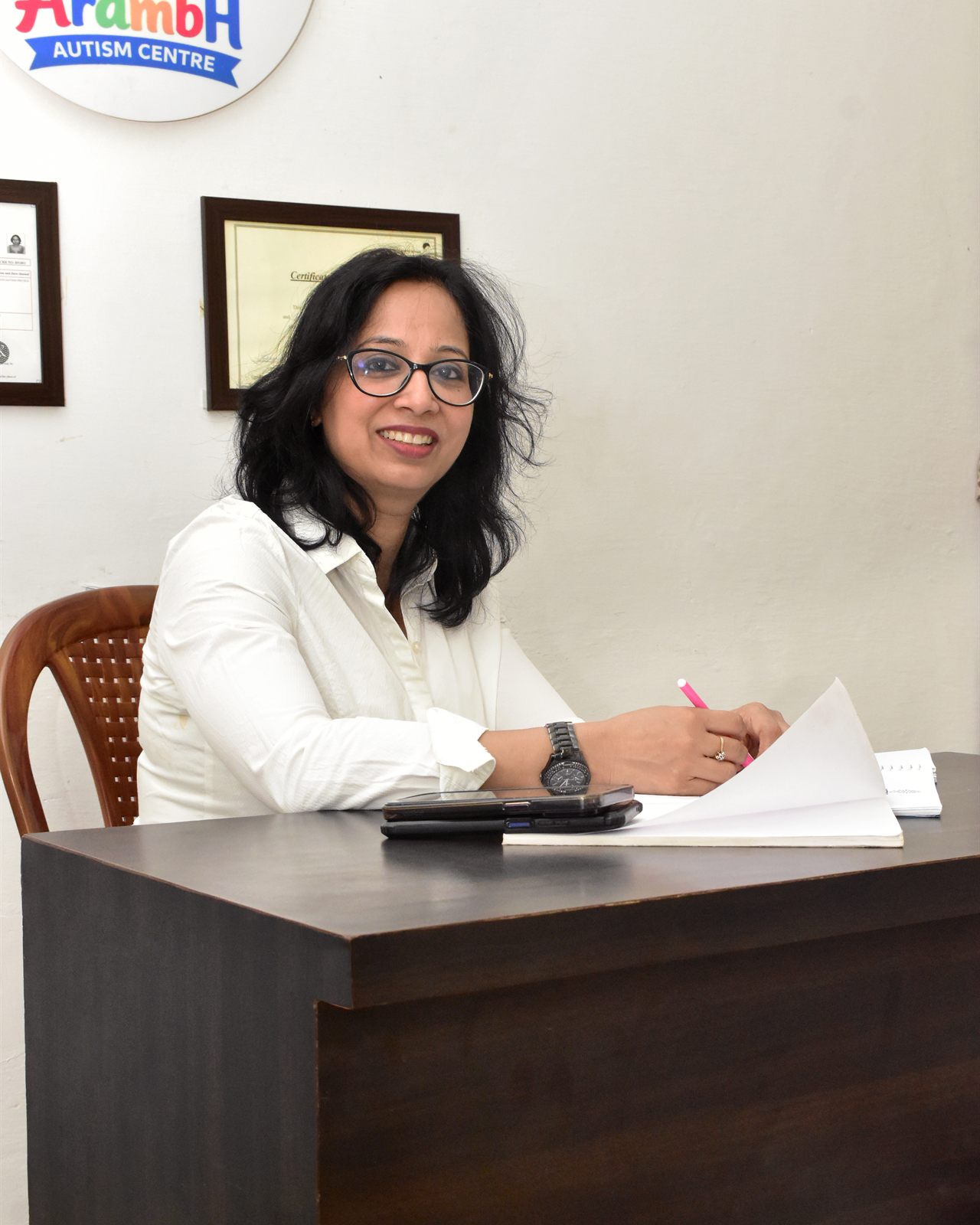
Pooja Gupta
Pooja Gupta is the founder of ArambH Autism Centre and an RCI registered Special Educator (CRR B51893) with 14 years of experience across New Delhi and Varanasi. She holds a Diploma in Special Education (Autism Spectrum Disorder) from IGNOU.