Autism Diagnosis Process in India
It usually doesn’t start with a diagnosis.
It starts with a feeling.
Neha noticed her son Kabir was not like other children in the park. While other children were running, laughing, and calling their parents… Kabir was sitting alone, quietly playing with a single toy.
She called his name.
No response.
At home, her husband said, “Don’t worry… boys are like this.”
Her mother-in-law said, “He will speak when the time comes.”
But a mother feels what others don’t.
Days turned into months.
And that one question stayed in her heart:
“Should I get him checked?”
If you are reading this right now, maybe you are standing at the same point.
First, Let’s Clear One Important Thing
Getting a diagnosis does not mean something is wrong with your child.
It simply means you are trying to understand your child better.
And that is not weakness.
That is responsibility.
That is love.
Diagnosis is not about labeling your child.
It is about helping your child.
What Does “Diagnosis” Actually Mean?
In simple words, diagnosis means understanding your child’s development.
It helps answer questions like:
Why is my child not speaking?
Why does my child not respond?
Why does my child behave differently?
It gives clarity.
Before diagnosis, there is confusion.
After diagnosis, there is direction.
And that direction matters.
When Should Parents Think About Diagnosis?
Most parents wait.
They observe.
They compare.
They hope things will improve.
And sometimes, they do.
But there are certain signs you should not ignore:
Your child is not speaking like other children of the same age
Your child does not respond to their name
Eye contact is very less
Your child prefers to stay alone most of the time
Repetitive behaviour (doing the same thing again and again)
If you are noticing more than one of these signs, it is better to check early.
Not because something is wrong.
But because your child may need support.
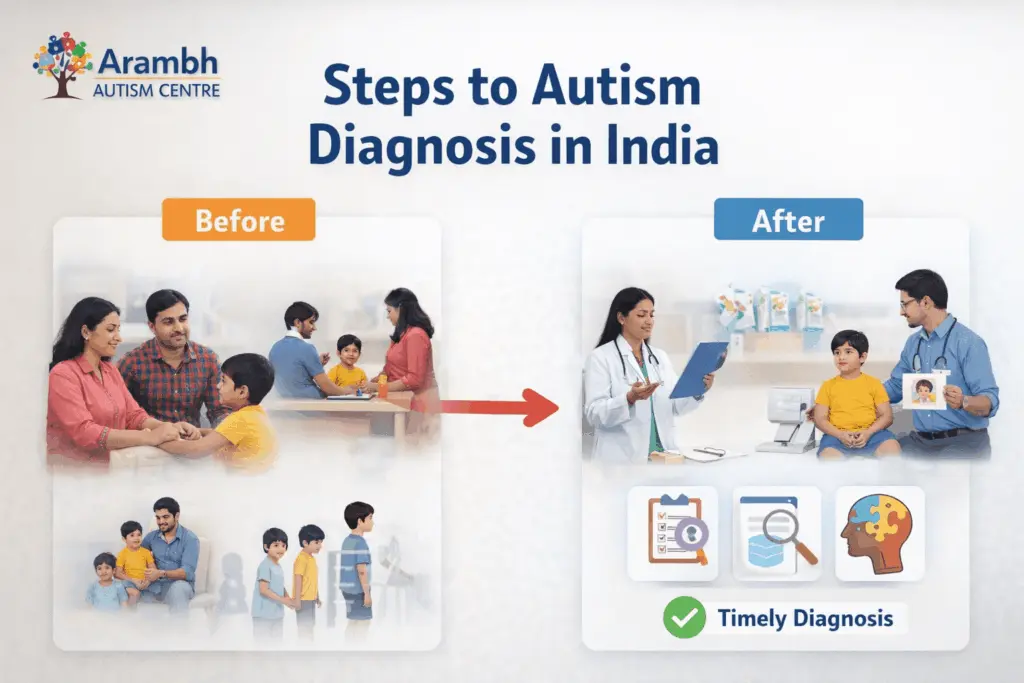
Step 1: Accepting the Doubt
This is the most difficult step.
Not because it is complicated, but because it is emotional.
Parents often feel:
“Maybe I am overthinking”
“What will people say?”
“Let’s wait a little more”
These thoughts are normal.
But waiting too long can delay help.
The moment you accept, “I need clarity,” everything starts moving forward.
Step 2: Visiting a Child Specialist
The next step is simple.
Visit a doctor who understands children.
In India, this is usually a pediatrician.
You don’t need to search for complicated terms.
Just start with a trusted child doctor.
They will:
Ask about your child’s behaviour
Observe your child
Ask questions about speech, play, and response
Sometimes they may say everything is fine.
Sometimes they may suggest further evaluation.
Both are okay.
Step 3: Developmental Assessment
If the doctor feels more clarity is needed, they will suggest an assessment.
This is not something to fear.
There are no injections.
No machines.
It is a simple process where professionals:
Play with your child
Observe how your child reacts
Ask you questions about daily behaviour
They check:
How your child communicates
How your child understands things
How your child interacts with others
This step gives a deeper understanding.
Step 4: Meeting a Team of Experts
In many cases, more than one expert may be involved.
You might meet:
A psychologist
A speech therapist
An occupational therapist
Don’t feel overwhelmed by these names.
Each one focuses on one area:
Communication
Behavior
Daily activities
Together, they create a complete picture of your child’s development.
Step 5: Final Diagnosis
After all the observations and assessments, you will get clarity.
The doctor may say:
Your child shows signs of autism
Your child has a developmental delay
Your child needs monitoring for some time
This moment can feel heavy.
Many parents go silent.
Some cry.
Some feel numb.
Some feel scared.
All of this is normal.
But remember one thing:
Now you know what to do.
A Real Feeling Parents Go Through
When Neha got Kabir’s diagnosis, she didn’t react immediately.
She just sat quietly.
Her mind was full of questions:
“Why my child?”
“What will happen in the future?”
“Will he be okay?”
But slowly, something changed.
Before diagnosis, she was confused.
After diagnosis, she had direction.
And direction brings strength.
What Happens After Diagnosis?
After diagnosis, the focus shifts to support.
Your child may be guided towards therapies that help in:
Speaking better
Understanding better
Connecting with others
Learning daily skills
These are not treatments in a scary sense.
They are simple, structured ways to help your child grow.
And the earlier you start, the better the results.
Why Early Diagnosis Matters So Much
A child’s brain develops very fast in the early years.
This is the best time to help them learn.
When support starts early:
Improvement is faster
Learning becomes easier
Communication improves
If delayed, progress is still possible.
But it takes more time.
That’s the only difference.
Common Mistakes Parents Make
Many parents unknowingly make these mistakes:
Waiting too long
Trusting random advice from relatives
Comparing with other children
Ignoring their own doubts
These delays don’t help the child.
They only delay progress.
And in early years, time matters a lot.
Emotional Truth Every Parent Needs to Hear
You are not at fault.
You did nothing wrong.
This is not because of your parenting.
Autism is simply a different way a child’s brain works.
Blaming yourself will not help.
Understanding your child will.
Where You Can Get Help
If you are in or around Varanasi and feeling confused about what to do next, you can connect with Arambh Autism Centre.
This centre is not built just on knowledge.
It is built on real experience.
Pooja Gupta, the owner, is herself a mother of an autistic child named Pihu.
She understands what parents go through:
The fear
The confusion
The silence
The questions
And that understanding makes a real difference.
You can talk to her directly:
Contact: 9455920030
Sometimes, speaking to someone who has lived this journey makes things clearer and easier.
One Small Step Can Change Everything
If you are reading this, you already care.
And that is your biggest strength.
You don’t need to figure everything out today.
You just need to take one step:
Observe
Ask
Consult
That’s it.
Final Thought
Diagnosis is not something that limits your child.
It is something that helps your child.
Your child still has:
A future
A voice
A path
But that path becomes clearer when you act early.
So if there is even a small doubt in your heart…
Don’t ignore it.
Because sometimes, that small doubt is the beginning of the right decision.
See how starting early can help your bachcha grow better.