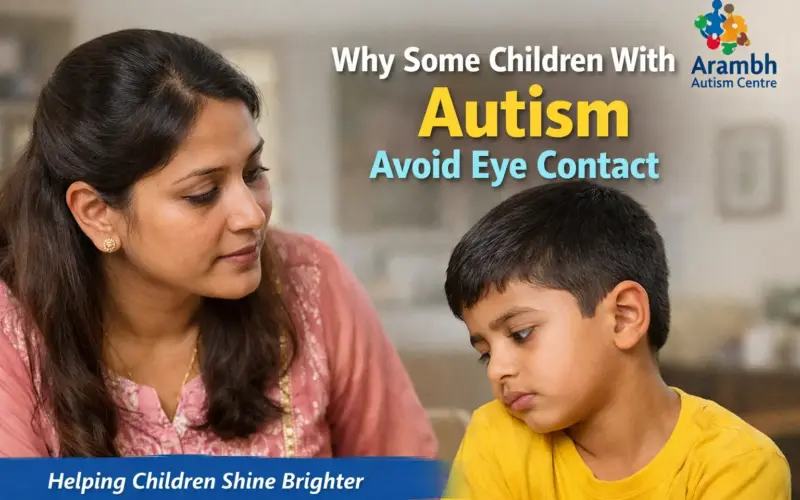
Why Some Children With Autism Avoid Eye Contact
Neha sat in front of her 3-year-old son, Vivaan.
She smiled.
“Look at mamma…”
Vivaan didn’t look.
He kept staring at the spinning fan above.
She moved closer. Held his face gently.
“Vivaan… look at me beta…”
For a second, he glanced… and then looked away again.
That small moment stayed in her mind the whole day.
“Why doesn’t my child look into my eyes?”
If you’ve ever felt this…
You are not alone.
Eye Contact… It’s More Than Just Looking
When a child looks into your eyes, something beautiful happens.
They connect.
They understand.
They share a moment.
It’s not just about “seeing”…
It’s about feeling connected.
That’s why when a child avoids eye contact, parents feel:
-
“Is my child ignoring me?”
-
“Does my child not recognize me?”
-
“Did I do something wrong?”
Let’s understand this gently.
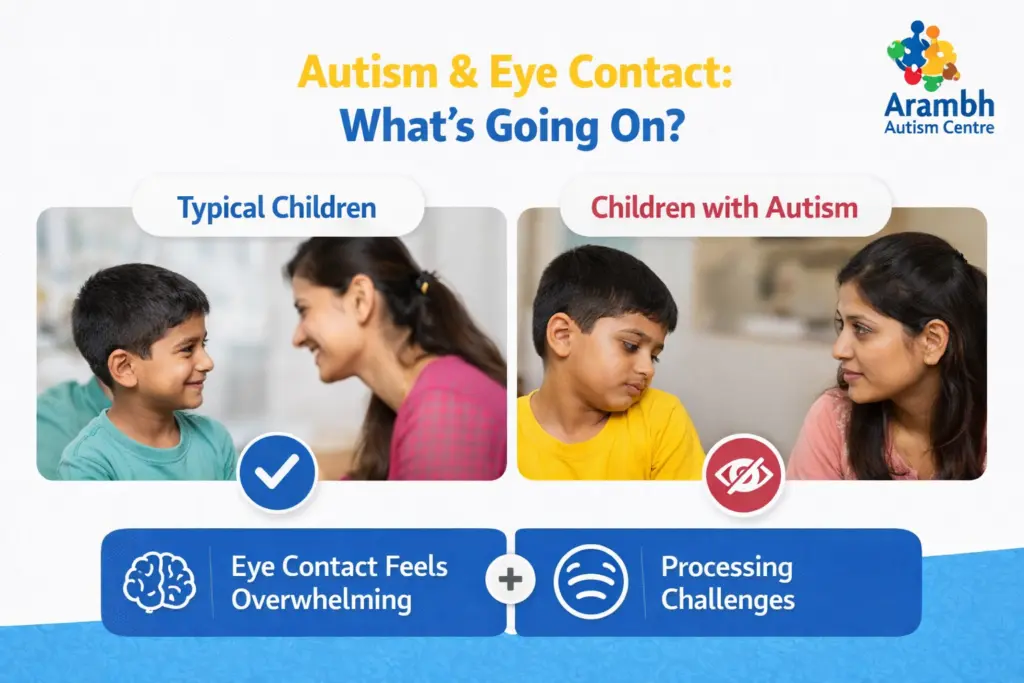
First Truth: Your Child Is Not Ignoring You
This is very important.
When a child avoids eye contact, it does NOT mean:
-
They don’t love you
-
They don’t recognize you
-
They don’t care
In fact…
Many children feel deeply connected…
Just in a different way.
They may show love by:
-
Sitting close
-
Holding your hand
-
Coming near you silently
But not through eye contact.
Why Do Some Children Avoid Eye Contact?
Let’s break this down in simple, real-life understanding.
1. Eye Contact Feels Overwhelming
For many children, looking into someone’s eyes is not simple.
It feels intense.
Imagine someone staring directly into your eyes for long…
You might feel uncomfortable.
Now imagine feeling that discomfort every time.
So the child looks away.
Not to disconnect…
But to feel calm.
2. Their Brain Processes Things Differently
Some children focus on one thing at a time.
When they are:
-
Listening
-
Thinking
-
Watching something
They may not look at you at the same time.
It’s not that they are not listening…
They just process things differently.
3. They Feel Safer Looking Away
Eye contact can feel like pressure.
Especially when someone expects a response.
So the child feels safer:
-
Looking at objects
-
Looking down
-
Looking elsewhere
It helps them stay relaxed.
4. They Don’t Yet Understand Social Signals
Most children learn naturally:
“Look at someone when they talk”
But some children don’t pick this up easily.
Not because they can’t…
But because it doesn’t come automatically to them.
They need support to learn it.
5. They Are More Interested in Things Than Faces
Some children get deeply focused on:
-
Lights
-
Fans
-
Toys
-
Patterns
Faces may not attract their attention the same way.
So they look at things… not people.
A Real Story That Changed Everything
Pooja Gupta noticed the same thing in her daughter, Pihu.
No eye contact.
Even when she called her with love…
Pihu would look away.
At first, it hurt.
It felt like distance.
Like something was missing.
People said:
“She is just shy.”
“She will improve with time.”
But a mother feels deeper than words.
Pooja waited.
Hoped.
But slowly, she understood:
This was not about shyness.
This was a sign.
And when she finally took action…
She realized:
Eye contact can be improved…
But only when you understand the child first.
Today, as the founder of Arambh Autism Centre, she helps parents who are going through the same confusion she once faced.
Why Forcing Eye Contact Can Make Things Worse
Many parents try this:
“Look at me when I talk!”
They hold the child’s face.
They insist.
They repeat again and again.
But here’s the truth:
Forcing eye contact can make the child:
-
More uncomfortable
-
More anxious
-
More avoidant
Instead of helping… it creates pressure.
And pressure pushes the child further away.
What You Should Do Instead
Let’s keep this simple and practical.
1. Don’t Force… Create Comfort
Sit near your child.
Play with them.
Join their world first.
When they feel safe…
They may naturally start looking at you.
2. Get Down to Their Level
Instead of calling from far…
Sit in front of them.
At their eye level.
Make it easier for them to notice you.
3. Use What They Love
If your child likes:
-
Bubbles
-
Toys
-
Snacks
Use those moments.
Hold it near your face.
So when they look at it…
They also see you.
4. Celebrate Small Progress
Even if your child looks for:
-
1 second
-
2 seconds
That is progress.
Don’t expect perfection.
Small steps matter.
5. Build Connection First, Eye Contact Later
Eye contact is not the goal.
Connection is.
If your child feels connected…
Eye contact will slowly follow.
A Message Every Parent Needs To Hear
Your child avoiding eye contact…
Is not rejection.
It is communication.
A different kind.
And once you understand it…
Everything changes.
When Should You Take It Seriously?
If your child:
-
Rarely makes eye contact
-
Doesn’t respond to name
-
Has delayed speech
-
Prefers to stay alone
Then don’t ignore it.
Not because something is “wrong”…
But because early help can make things easier.
You Are Not Alone In This Journey
Many parents feel:
-
Confused
-
Worried
-
Guilty
But the truth is…
You are trying your best.
And now, you are becoming aware.
That is powerful.
Take The First Step Today
If you are noticing these signs…
Don’t wait for things to “fix themselves”.
Early support can make a big difference.
You can talk to Pooja Gupta, a mother who understands this journey deeply and helps children through Arambh Autism Centre.
📞 Call or WhatsApp: 9455920030
Sometimes, just one conversation…
Can give you clarity, direction, and hope.
Final Thought
Your child may not look into your eyes…
But that doesn’t mean they are not connected to you.
They just need a different path…
To reach you.
And with the right support…
They will.
Learn how we help children connect with others.