Autism vs Speech Delay: How Parents Can Tell the Difference
Neha started noticing small things about her son, Vivaan.
He was 2 years old.
Still not speaking.
“Maybe he will talk late…” she told herself.
But then she noticed something else.
When she called his name… he didn’t turn.
When she tried to play… he stayed in his own world.
But her neighbour’s child, who also spoke late, would still:
-
Look at his mother
-
Smile
-
Point at things
That’s when Neha felt confused.
“Is this just speech delay… or something more?”
If you are asking the same question…
You are not alone.
First, Let’s Understand One Simple Truth
Not every child who speaks late has autism.
And not every child with autism speaks late in the same way.
This is where many parents get confused.
Speech delay is about talking late.
Autism is about connection, communication, and behavior.
Both may look similar at first.
But there are clear differences… if you know what to observe.
What Is Speech Delay (In Simple Words)
Speech delay means:
Your child is not speaking as per age, but everything else feels mostly normal.
You may notice:
-
Child understands what you say
-
Responds when called
-
Uses gestures like pointing or waving
-
Tries to communicate in other ways
Even without words… the child is trying to connect.
That connection is very important.
What Is Autism (In Simple Words)
Autism is not just about speech.
It affects how a child:
-
Connects with people
-
Understands emotions
-
Communicates (with or without words)
-
Behaves in daily situations
Speech delay can be one part of it.
But the bigger difference is lack of connection and interaction.
The Biggest Difference: Connection
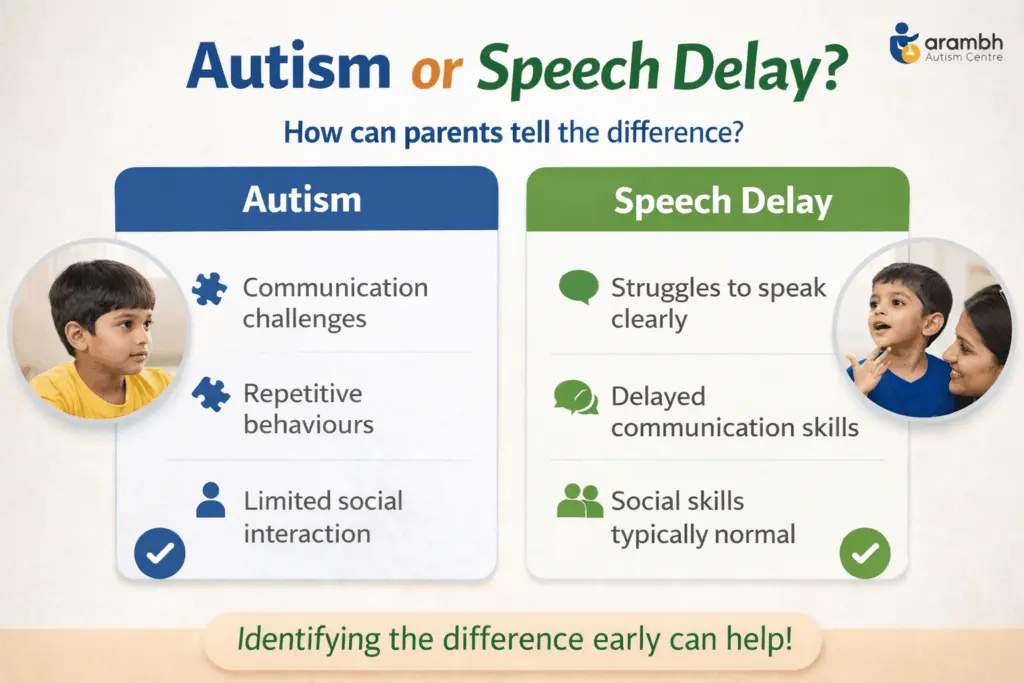
Let’s make it very simple.
A child with speech delay:
👉 Wants to connect… but cannot express properly
A child with autism:
👉 Struggles to connect itself
This one difference can change everything.
Key Differences Parents Should Observe
Let’s look at real-life situations.
1. Responding to Name
Speech Delay:
You call your child…
They turn and look.
Maybe they don’t speak… but they respond.
Autism:
You call again and again…
No response.
It feels like they didn’t hear… even when hearing is normal.
2. Eye Contact
Speech Delay:
-
Looks at you
-
Smiles back
-
Enjoys interaction
Autism:
-
Avoids eye contact
-
Looks away often
-
Does not hold gaze
Eye contact is a strong sign of connection.
3. Use of Gestures
Speech Delay:
-
Points at things
-
Waves bye
-
Shows objects to parents
Even without words, they communicate.
Autism:
-
Rarely points
-
Does not wave
-
Does not try to “share” things
4. Understanding Language
Speech Delay:
If you say:
“Bring the ball”
They understand and try to bring it.
Autism:
Understanding may be limited.
Or inconsistent.
Sometimes they seem to understand… sometimes not.
5. Playing Behaviour
Speech Delay:
-
Plays with toys properly
-
Imitates others
-
Enjoys simple games
Autism:
-
Repeats same activity again and again
-
Spins wheels, lines up toys
-
Less imaginative play
6. Social Interest
Speech Delay:
-
Enjoys being around people
-
Seeks attention
-
Likes interaction
Autism:
-
Prefers being alone
-
Does not seek attention
-
Lives in own world
7. Emotional Response
Speech Delay:
-
Smiles
-
Shows excitement
-
Reacts to parents
Autism:
-
Limited emotional expression
-
Does not react as expected
A Real Story That Explains Everything
Pooja Gupta, a mother from Prayagraj, went through the same confusion.
Her daughter Pihu was not speaking.
At first, everyone said:
“Speech delay hai… thik ho jayega.”
But Pooja noticed deeper signs:
-
No eye contact
-
No response to name
-
No gestures
She trusted her instinct.
And when she finally got guidance…
She understood the difference.
It was not just speech delay.
That early realization helped her take action.
Today, Pooja not only supports her own child…
She helps hundreds of parents through Arambh Autism Centre.
Because she knows how confusing this phase can be.
Why Parents Get Confused
Because both conditions can look similar in the beginning.
Both may include:
-
Late talking
-
Limited words
But the mistake happens when parents only focus on speech.
Instead, observe:
👉 Is my child trying to connect?
That one question gives clarity.
Why Early Identification Matters
Time matters.
A lot.
When support starts early:
-
Children learn faster
-
Communication improves
-
Behaviour becomes easier to manage
Waiting doesn’t make things better.
Early action does.
What Should You Do If You Are Confused?
Take a simple approach:
Step 1: Observe
Watch your child in daily life.
Not just speech… but:
-
Response
-
Eye contact
-
Interaction
Step 2: Trust Your Instinct
If something feels off…
Don’t ignore it.
Parents are usually right.
Step 3: Talk to a Child Expert
Not random advice.
Not Google confusion.
Talk to someone who understands child development.
Step 4: Start Early Support (If Needed)
Early support is not a label.
It is help.
And help changes outcomes.
For Parents Who Are Feeling Worried Right Now
Take a deep breath.
You are not late.
You are here.
And that matters.
Feeling worried doesn’t mean something is wrong.
It means you care enough to notice.
And that is the first step.
One Honest Truth
Many parents wait… hoping things will improve.
Some children do improve.
But some need support.
And delay only makes things harder.
Not impossible.
Just harder.
Your Child Needs Awareness, Not Assumptions
“Speech delay hai” — this assumption can delay the right help.
“Let’s check properly” — this approach can change your child’s future.
Take Action Today, Not Later
If you are confused between autism and speech delay…
Don’t stay stuck in confusion.
Talk to someone who understands both.
You can connect with Pooja Gupta, a mother who has walked this journey herself and now helps other parents through Arambh Autism Centre.
📞 Contact: 9455920030
She understands your fear.
Your confusion.
And your hope.
Final Thought
Your child is trying to tell you something…
Maybe not with words.
But through behavior.
Through actions.
Through silence.
All you need to do…
Is notice the difference.
And take the first step.
Learn how we help children start speaking.