Mild Autism Symptoms Parents Often Miss
It didn’t look serious at first.
Rohit and Meena felt lucky.
Their daughter Anaya was calm, quiet, and never created trouble. She could sit alone for long periods, didn’t demand attention, and seemed “easy to handle.”
Relatives would say,
“Such a good child… not like other naughty kids.”
Meena smiled.
But somewhere deep inside, a small question stayed:
“Why doesn’t she call me like other children do?”
“Why doesn’t she show me things?”
It wasn’t obvious.
It wasn’t loud.
It was… subtle.
And that is exactly why mild autism symptoms are often missed.
What Does “Mild Autism” Really Mean?
When people hear the word autism, they imagine something very visible.
No speech.
No interaction.
Clear differences.
But that’s not always the case.
Some children:
Speak normally
Go to school
Follow instructions
And still… struggle in ways that are not immediately visible.
This is often called “mild autism.”
Not because it is less important.
But because the signs are softer… harder to notice.
Why Parents Often Miss These Signs
Because everything looks “almost normal.”
The child:
Eats well
Sleeps well
Goes to school
Learns things
So parents think:
“Everything is fine.”
But the challenges are hidden in small daily behaviours.
And if you’re not looking closely, you might miss them.
1. Your Child Speaks… But Conversations Feel One-Sided
Your child can talk.
They may even have a good vocabulary.
But something feels different.
They:
Talk only about their favourite topic
Don’t respond properly when you talk
Don’t continue conversations
For example, you ask, “How was your day?”
They might ignore it or change the topic.
It’s not about speaking.
It’s about connecting.
2. Difficulty Making or Keeping Friends
Your child goes to school.
But when you ask:
“Who is your best friend?”
There is no clear answer.
Or they may say a name…
But there is no real connection.
They might:
Play alone in school
Not understand group games
Struggle to share or take turns
Teachers may say:
“He is fine, just a little reserved.”
But deep down, the child is struggling socially.
3. Doesn’t Understand Social Signals
Most children naturally understand:
When someone is upset
When to say sorry
When to smile or react
But some children don’t pick these up easily.
For example:
Someone falls…
Other kids react…
Your child continues playing.
Not because they don’t care.
But because they don’t understand the situation.
4. Very Fixed Interests
Your child may become deeply focused on one thing.
For example:
Only cars
Only numbers
Only one cartoon
And they can talk about it endlessly.
They may:
Repeat the same topic again and again
Get upset if interrupted
Not show interest in other things
It may look like passion.
But when it becomes too rigid, it’s a sign to notice.
5. Gets Upset With Small Changes
You change a small routine…
And suddenly, your child becomes very upset.
For example:
A different route to school
A new teacher
Food served differently
They may:
Cry
Get irritated
Refuse to adjust
Other children adjust slowly.
But here, even small changes feel big.
6. Unusual Play Patterns
Your child plays.
But not in the usual way.
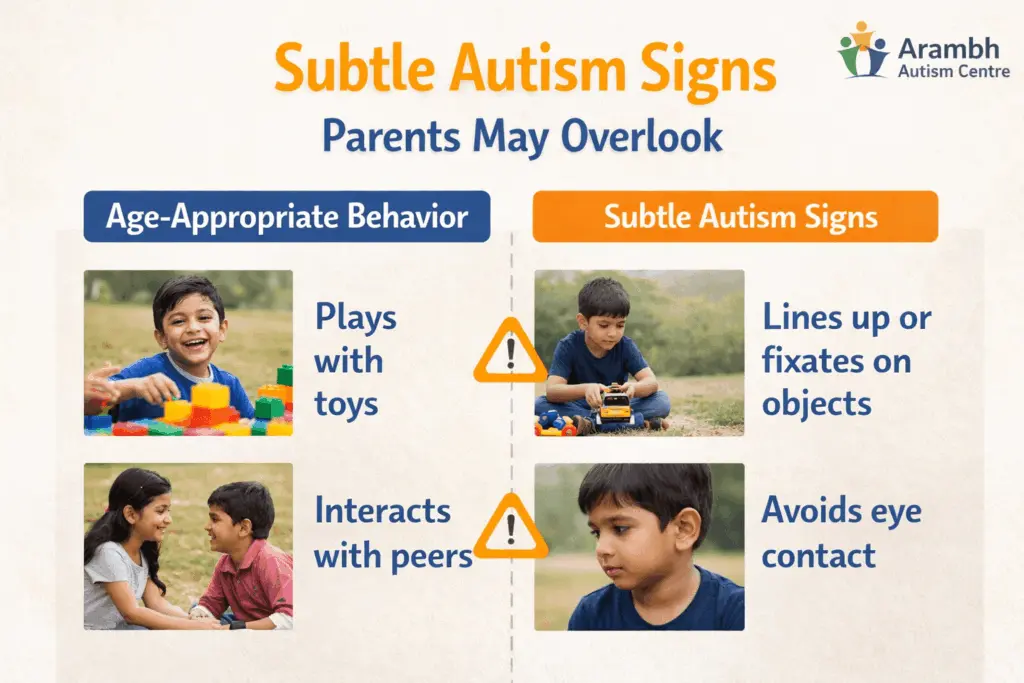
Instead of using toys fully, they may:
Line them up
Spin parts of the toy
Focus on one small part
For example:
Spinning the wheel of a car… again and again.
It may look harmless.
But repeated patterns like this matter.
7. Limited Eye Contact (But Not Completely Absent)
In severe cases, eye contact is missing.
But in mild cases, it’s inconsistent.
Your child may:
Look sometimes
Avoid at other times
Not hold eye contact for long
It’s subtle.
But noticeable if you observe closely.
8. Delayed Emotional Response
You smile…
They smile after a delay.
You call them…
They respond after some time.
It’s not absence.
It’s delay.
And this delay is often ignored.
9. Sensitivity to Sounds, Lights, or Touch
Some children react strongly to:
Loud sounds
Bright lights
Certain clothes
They may:
Cover their ears
Avoid crowded places
Refuse certain textures
Parents often think:
“He is just sensitive.”
But repeated patterns matter.
10. Follows Instructions… But Lacks Understanding
Your child may follow instructions like:
“Bring water”
“Sit here”
But when it comes to understanding emotions or situations…
They struggle.
For example:
You explain something emotional…
They don’t react or understand.
It feels like they are present…
But not fully connected.
A Truth Many Parents Realize Late
Mild symptoms don’t shout.
They whisper.
And because they whisper…
They are easy to ignore.
Parents often realize later:
“All the signs were there… we just didn’t see them clearly.”
Why Early Attention Still Matters
Even if symptoms are mild…
Support can make a big difference.
It can help your child:
Communicate better
Build friendships
Understand emotions
Adjust to situations
Without support, these challenges can grow with age.
With support, they can improve.
What Should You Do If You Notice These Signs?
First, don’t panic.
Second, don’t ignore.
Just observe carefully.
Ask yourself:
Are these behaviours happening regularly?
Are they affecting my child’s daily life?
If yes, take the next step:
Talk to a child specialist
Get a proper understanding
Start early support if needed
This is not overreacting.
This is responsible parenting.
A Message Every Parent Needs
Your child is not “less.”
Your child just understands the world differently.
And with the right support…
They can learn, grow, and shine in their own way.
You Are Not Alone in This Journey
If you are in Varanasi and noticing these mild signs but feeling confused…
You can connect with Arambh Autism Centre.
Here, you won’t just get guidance.
You’ll get understanding.
Pooja Gupta, the owner, is herself a mother of an autistic child, Pihu.
She has lived this journey.
She understands what it feels like to doubt, to wait, and to finally take action.
You can talk to her directly:
Contact: 9455920030
Sometimes, one conversation can give you the clarity you need.
Final Thought
Mild signs are easy to ignore.
But early action is powerful.
You don’t need certainty to take a step.
You just need awareness.
Because when you notice early…
You give your child a better chance at a smoother future.
And that one step…
Can change everything.