Autism Symptoms in Toddlers (Age 1–3)
Neha was sitting on the floor with her 18-month-old daughter, Myra.
She picked up a soft toy, smiled, and said,
“देखो बेटा… teddy!”
Myra didn’t look.
She kept staring at the fan.
Neha moved closer.
“Say mama… mama…”
No response.
Just silence.
That night, Neha couldn’t sleep.
Not because something big had happened…
But because something small… kept repeating.
And somewhere deep inside, a mother’s heart already knew:
“Something feels different.”
Every Toddler Is Unique… But Patterns Matter
Between the age of 1 to 3 years, children change very fast.
-
They start speaking
-
They respond to their name
-
They show emotions
-
They connect with people
But sometimes…
A child may not follow these patterns.
Not in one way.
But in many small ways.
And these small signs, when seen together… matter.
What Most Parents Think (And Why It Delays Action)
You may have already heard things like:
-
“Abhi chhota hai, bolna start karega”
-
“Boys speak late, don’t worry”
-
“Mobile de do, busy rahega”
-
“Normal hai, sab bachche alag hote hain”
And yes…
Every child is different.
But when the same signs repeat again and again…
It’s not about comparison.
It’s about awareness.
Common Autism Symptoms in Toddlers (1–3 Years)
Let’s understand this in a simple, real-life way.
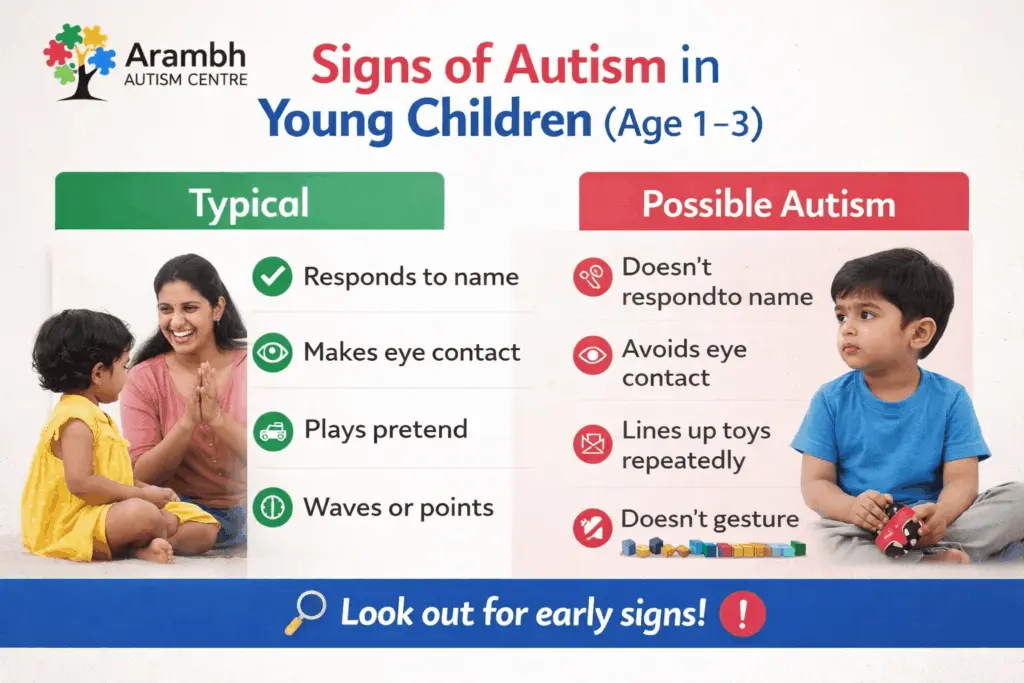
1. Not Responding to Name
You call your child…
Once.
Twice.
Many times.
But they don’t respond.
Sometimes it feels like they didn’t hear.
But when a sound they like comes…
They react immediately.
This difference is important.
2. Limited or No Eye Contact
You try to connect…
But your child avoids eye contact.
They look at objects more than faces.
Even during feeding, playing, or talking…
They rarely look into your eyes.
Eye contact is the first step of connection.
3. Delay in Speech or No Speech
By this age, many toddlers start saying small words like:
-
Mama
-
Papa
-
Ball
-
Give
But some children:
-
Don’t speak at all
-
Speak very few words
-
Stop using words they already learned
This is one of the most noticeable signs.
4. Repeating Words Without Meaning
Some toddlers speak…
But instead of using words properly, they:
-
Repeat the same words
-
Copy lines from cartoons
-
Say things again and again
It sounds like speech…
But it’s not real communication.
5. Playing Alone Most of the Time
Your child plays…
But doesn’t include you.
They don’t:
-
Show toys
-
Invite you
-
Enjoy group play
Even with other children…
They stay separate.
It feels like they are in their own world.
6. No Pointing or Gestures
Most toddlers point to show interest:
-
“Woh chahiye”
-
“Dekho dog!”
But some children:
-
Don’t point
-
Don’t wave
-
Don’t use gestures
They don’t try to share what they see or feel.
7. Unusual Play Patterns
Instead of playing normally, your child may:
-
Spin wheels of toys repeatedly
-
Line up objects
-
Focus on one part of a toy
For example:
Instead of playing with a car…
They only spin its wheels again and again.
8. Lack of Emotional Connection
You laugh…
They don’t react.
You call them with love…
They don’t come.
They may not:
-
Smile back
-
Show excitement
-
Express feelings clearly
It feels like a gap in connection.
9. Strong Reactions to Small Changes
Some toddlers get very upset when:
-
Routine changes
-
Toys are moved
-
Daily pattern is disturbed
They may cry, shout, or become very restless.
Small changes feel big for them.
10. Very Little Interest in People
Your child may:
-
Not notice when someone enters the room
-
Not respond to familiar faces
-
Not show interest in interacting
It feels like people are not their focus.
A Real Story That Many Parents Relate To
Pooja Gupta noticed these signs in her daughter, Pihu.
At first, she thought:
“She is just quiet.”
But slowly…
-
No speech
-
No response
-
No eye contact
The signs became clearer.
Like many parents, she waited.
Hoping time would fix everything.
But time passed…
And the gap increased.
When she finally took action…
She realised something powerful:
Early support could have made things easier.
That moment changed her life.
Today, she runs Arambh Autism Centre, helping parents who are standing exactly where she once stood.
Why Early Identification Matters
Between 1–3 years, a child’s brain grows very fast.
This is the best time to:
-
Improve communication
-
Build connection
-
Develop learning skills
When support starts early…
Progress becomes easier.
When delayed…
Effort becomes more.
Not impossible.
But harder.
What You Should Do As a Parent
First thing:
Don’t panic.
Second:
Don’t ignore.
Just observe your child closely.
Ask yourself:
-
Does my child connect with me?
-
Does my child try to communicate?
-
Are these signs repeating?
If yes…
Take the next step.
-
Talk to a child expert
-
Get proper guidance
-
Start early support if needed
You are not labelling your child.
You are helping your child.
A Message From One Parent to Another
If you are reading this and feeling worried…
You are not alone.
Every parent goes through this phase of doubt.
But the difference is:
Some wait.
Some act.
And that one decision…
Changes the child’s future.
Don’t Wait for “Time Will Fix It”
Time doesn’t fix everything.
Right action does.
Early action does.
Your awareness does.
Talk to Someone Who Truly Understands
If you see even a few of these signs…
Don’t ignore them.
Speak to someone who understands both as an expert and a parent.
You can connect with Pooja Gupta, founder of Arambh Autism Centre, and a mother who has lived this journey with her daughter Pihu.
📞 Contact: 9455920030
She understands your fear…
Your confusion…
Your questions…
Because she has been there.
Final Thought
Your child is not behind.
Your child just needs a different kind of support.
And the earlier you start…
The better their journey becomes.
The first step is simple:
Notice.
Accept.
Act.