Can Autism Be Detected Early?
It often begins with a small doubt.
Nothing big.
Nothing very obvious.
Just small moments.
Your child doesn’t respond when you call.
They avoid eye contact.
They seem to be in their own world.
And then a thought comes:
“Is this normal… or should I be worried?”
Most parents don’t say it out loud.
But they search.
They observe.
They wait.
If you are here, you might be asking the same question:
“Can autism be detected early?”
The answer is simple.
Yes, it can.
But understanding how… and when… is very important.
First, Let’s Understand One Thing Clearly
Autism is not something that suddenly appears one day.
It develops slowly.
Which means…
The signs are also visible slowly.
Not always clearly.
Not always strongly.
But they are there.
In small behaviours.
In daily actions.
In the way a child connects (or doesn’t connect).
That is why early detection is possible.
At What Age Can Autism Be Detected?
Many parents think:
“Let the child grow… we will see later.”
But the truth is:
Some signs can be noticed as early as 12 to 18 months.
In some cases, even earlier.
By the age of 2 years, signs usually become clearer.
This doesn’t mean you should panic early.
It simply means:
You can start observing early.
And that makes a big difference.
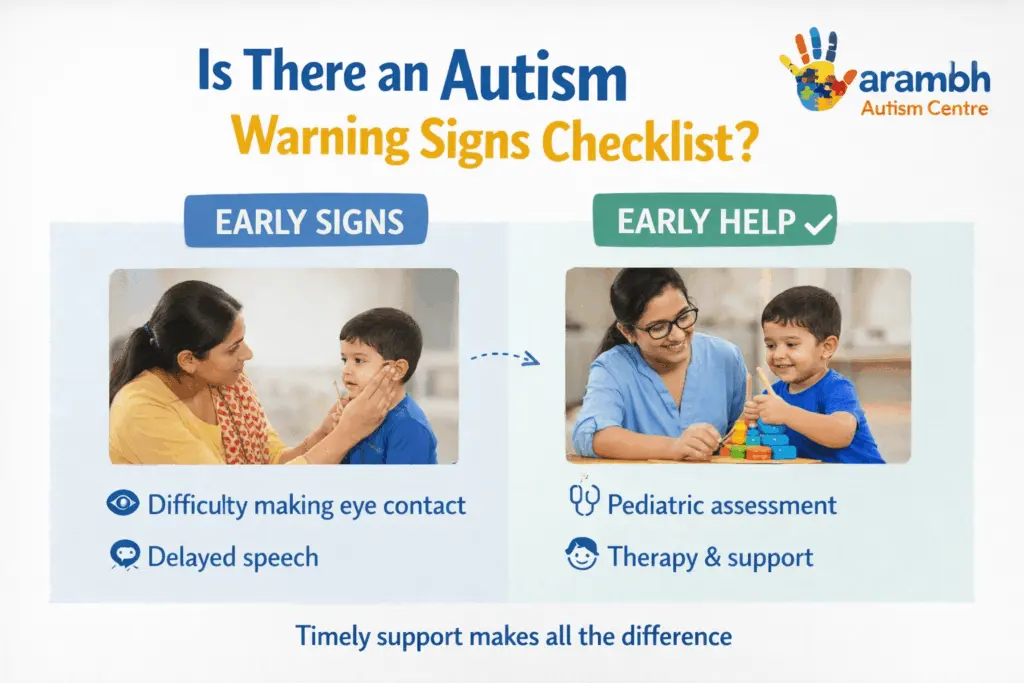
Early Signs You Can Notice at Home
You don’t need any test to start noticing.
You just need to observe your child’s everyday behaviour.
Here are some early signs:
1. Limited or No Eye Contact
You smile at your child.
But they don’t look back into your eyes.
It feels like they are avoiding connection.
2. Not Responding to Their Name
You call their name again and again.
But they don’t respond.
Even when they can hear other sounds clearly.
3. Delayed Speech
Other children start saying simple words.
But your child:
Doesn’t speak
Speaks very little
Or stops using words they learned
4. Not Pointing or Showing Things
Children usually point at things they want.
They show you objects.
They try to share their excitement.
But some children don’t do this.
They stay in their own space.
5. Repetitive Behaviour
Doing the same thing again and again:
Spinning objects
Repeating words
Following fixed routines
It may look harmless.
But repeated patterns matter.
6. Prefers Being Alone
Your child plays.
But mostly alone.
No interest in other children.
No effort to join others.
7. Limited Emotional Response
You laugh.
They don’t react.
You show excitement.
They stay neutral.
It feels like there is a gap in connection.
Why Parents Often Miss Early Signs
Here is the honest truth.
Most parents do notice something.
But they ignore it.
Not because they don’t care.
But because they hope everything will be fine.
They hear things like:
“Boys speak late”
“Every child is different”
“He will grow out of it”
And slowly…
Time passes.
That is the biggest reason early detection gets delayed.
A Real Story That Feels Close to Home
Pooja Gupta noticed something different in her daughter Pihu.
Pihu was very calm.
She didn’t trouble anyone.
At first, it felt like a blessing.
But slowly, Pooja realized:
No eye contact
No response to name
No proper speech
People around her said:
“She is just quiet.”
But a mother knows.
Still, like many parents, she waited.
Hoping things would change.
But they didn’t.
And when she finally took action, she understood one thing:
Early detection could have made the journey easier.
Today, Pooja Gupta helps other parents through Arambh Autism Centre, so they don’t have to go through the same delay.
Why Early Detection Is So Important
A child’s brain grows very fast in the early years.
This is the best time to support them.
When autism is detected early:
Communication improves faster
Learning becomes easier
Social connection gets better
If detected late:
Improvement is still possible.
But it takes more time and effort.
Early detection doesn’t change your child.
It changes how early you can help your child.
What Should You Do If You Notice Signs?
First, don’t panic.
Second, don’t ignore.
Just take simple steps:
Observe your child regularly
Note down behaviours that concern you
Talk to a child specialist
You don’t need to confirm anything yourself.
You just need clarity.
And that comes from the right guidance.
One Important Truth Every Parent Should Hear
You are not overthinking.
And you are not wrong for noticing.
Sometimes, your instinct is the first sign.
Trust it.
Taking action early is not being negative.
It is being responsible.
Where You Can Get Guidance
If you are in or around Varanasi and feeling unsure about what to do next, you can connect with Arambh Autism Centre.
This place is not just about therapy.
It is built on real experience.
Pooja Gupta, the owner, is herself a mother of an autistic child named Pihu.
She understands:
The confusion
The fear
The questions in your mind
You can talk to her directly:
Contact: 9455920030
Sometimes, talking to someone who has lived this journey gives more clarity than anything else.
Final Thought
So, can autism be detected early?
Yes.
But only if we choose to notice.
Only if we choose not to ignore small signs.
Your child’s future does not depend on a label.
It depends on how early you understand and support them.
If there is even a small doubt in your heart…
Don’t wait.
Because early understanding leads to early support.
And early support can change everything.
Explore step-by-step early intervention for your child.