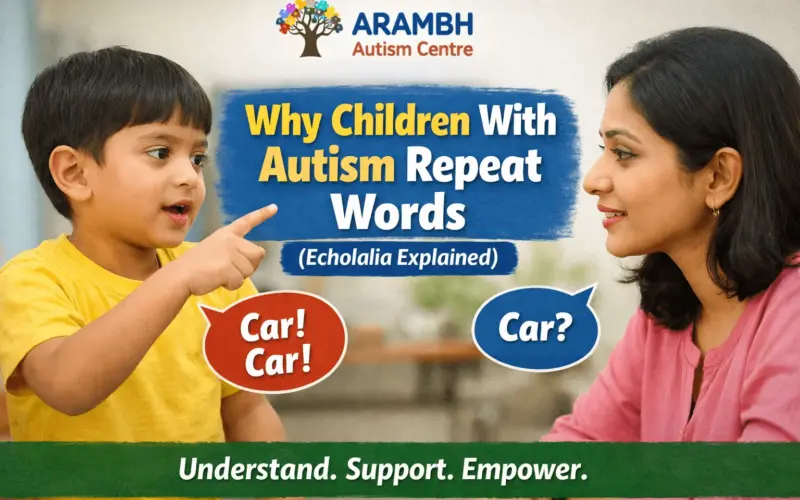
Why Children With Autism Repeat Words (Echolalia Explained)
Neha was in the kitchen when her son Kabir walked in.
He looked at her and said,
“Do you want water?”
Neha smiled and replied, “No beta, I’m fine.”
A few minutes later, Kabir said again,
“Do you want water?”
Then again.
And again.
At first, it felt cute.
But slowly, Neha realized something:
Kabir wasn’t asking.
He was repeating.
The same sentence.
Without meaning.
And that’s where confusion begins for many parents.
What Is Echolalia (In Simple Words)
Echolalia simply means:
When a child repeats words or sentences instead of using their own words to communicate.
That’s it.
No complicated meaning.
Just repetition.
But here’s the important part:
This repetition is not useless.
It has a reason.
Why Do Children Repeat Words?
Most parents think:
“My child is just copying.”
“He is not understanding anything.”
But the truth is different.
Children repeat words because:
-
They are trying to learn language
-
They don’t know how to express themselves
-
They find comfort in familiar sounds
-
They are processing what they hear
It’s not a problem in itself.
It’s a sign of how their brain is trying to understand the world.
Types of Echolalia You Might Notice
Let’s make this very simple.
There are mainly two ways children repeat words.
1. Immediate Repetition
You say something…
And your child repeats it instantly.
Example:
You: “Do you want milk?”
Child: “Do you want milk?”
Instead of answering yes or no…
They repeat the question.
This is very common.
2. Delayed Repetition
This is where it gets confusing.
Your child repeats something they heard earlier.
Maybe:
-
A cartoon dialogue
-
A sentence you said yesterday
-
An ad line
Example:
Your child suddenly says:
“Let’s go on a picnic!”
But there is no picnic.
No situation.
It feels random.
But for them, it has a connection.
Why It Feels So Scary For Parents
Because it looks like:
-
The child is not understanding
-
The child is stuck
-
The child is not progressing
And that fear is real.
You start comparing:
“Other kids are speaking normally…”
“Why is my child repeating?”
That comparison hurts.
But here’s something important:
Repetition is often a step before real communication.
Not the end.
What Your Child Is Actually Trying To Do
When your child repeats words, they might be:
-
Trying to answer but don’t know how
-
Trying to ask something using stored sentences
-
Trying to express feelings
-
Trying to calm themselves
Example:
A child says:
“Time to sleep!”
Maybe they are tired.
But instead of saying “I am sleepy”…
They use a sentence they already know.
This is their way of communicating.
A Real Story That Changes Perspective
Pooja Gupta remembers when her daughter Pihu started repeating lines from cartoons.
At first, it felt funny.
Pihu would say full sentences… perfectly.
But something was missing.
There was no connection to the situation.
If Pooja asked, “What do you want?”
Pihu would repeat a cartoon line instead.
People said:
“Wow, she speaks so well!”
But Pooja knew:
This was not real conversation.
It was repetition.
That’s when she understood something important:
Pihu was trying to communicate…
But didn’t know how to create her own words yet.
That realization changed her approach.
Instead of stopping Pihu…
She started guiding her.
And slowly, things improved.
Today, Pooja helps many parents at Arambh Autism Centre, because she has lived this journey herself.
When Should You Be Concerned?
Not every repetition is a problem.
Even normal children repeat words while learning.
But you should observe carefully if:
-
Your child only repeats, but doesn’t answer
-
Repetition continues for a long time without progress
-
Your child struggles to form their own sentences
-
There is limited understanding
It’s not about panic.
It’s about awareness.
What Parents Should NOT Do
Many parents react like this:
-
“Stop repeating!”
-
“Say properly!”
-
“Why are you talking like this?”
But this doesn’t help.
Because the child is not doing it intentionally.
They are trying their best.
Stopping them can create:
-
Frustration
-
Confusion
-
Emotional distance
What You SHOULD Do Instead
Here’s a better approach.
Simple. Practical.
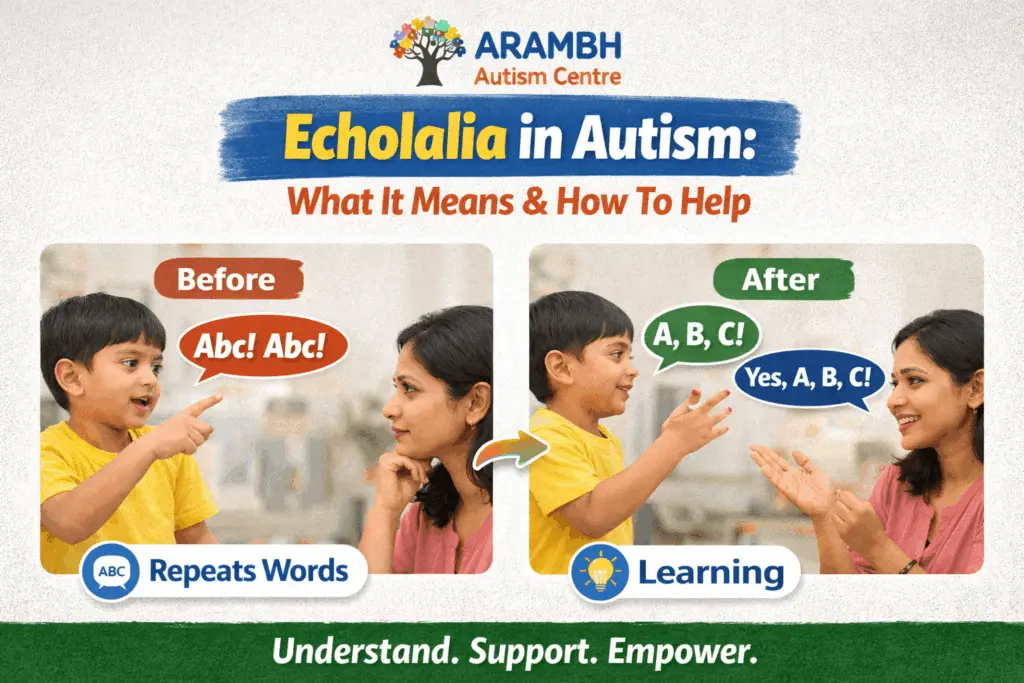
1. Turn Repetition Into Meaning
If your child repeats:
“Do you want water?”
You respond:
“Oh, you want water? Say ‘I want water’.”
Gently guide.
No pressure.
2. Give Simple Choices
Instead of open questions, try:
“Do you want water or juice?”
This helps them choose instead of repeating.
3. Use Short, Clear Sentences
Keep language simple.
Example:
Instead of:
“What would you like to drink right now?”
Say:
“Water or juice?”
4. Be Patient
Progress is slow.
But it happens.
Your calm response matters more than anything.
5. Seek Early Guidance
If repetition continues and you feel concerned…
Talk to a child expert.
Early support can:
-
Improve communication
-
Reduce frustration
-
Help your child express better
The Truth Most People Don’t Tell You
Echolalia is not the enemy.
Silence is.
Repetition means:
Your child is trying.
Trying to speak.
Trying to connect.
Trying to understand.
And that effort matters.
For Every Parent Feeling Confused
If you’re thinking:
“Is this normal?”
“Should I wait?”
“Am I overthinking?”
You’re not alone.
Every parent goes through this phase.
But the difference comes from one decision:
Ignoring… or acting.
A Small Step Today Can Change Everything
If your child is repeating words and you feel unsure…
Don’t wait too long.
Talk to someone who understands both:
A professional…
And a parent’s heart.
You can connect with Pooja Gupta, founder of Arambh Autism Centre, and a mother who has walked this path with her daughter, Pihu.
📞 Contact: 9455920030
Sometimes, one right conversation can bring clarity, relief, and direction.
Final Thought
Your child is not stuck.
Your child is learning… in a different way.
And with your support…
Those repeated words can slowly turn into meaningful conversations.
Just don’t ignore the signal.
Because inside those repetitions…
There is a voice waiting to be understood.
Understand how communication skills can improve.