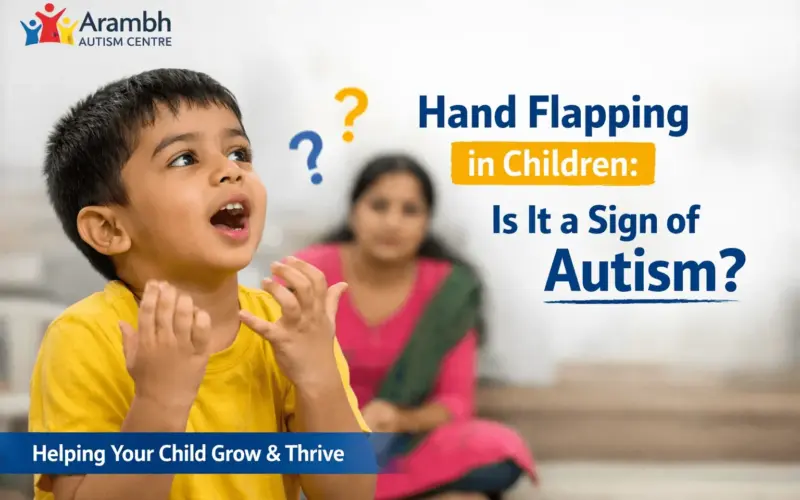
Hand Flapping in Children: Is It a Sign of Autism?
Neha was sitting in the living room, watching her 2-year-old daughter Myra play.
Suddenly, Myra got excited seeing her favourite cartoon.
She stood up… smiled… and started flapping her hands quickly.
Up and down.
Again and again.
Neha smiled at first.
“Cute,” she thought.
But then she noticed…
It wasn’t just once.
It happened every time Myra got excited.
Sometimes even when she was upset.
A small question quietly entered her mind:
“Is this normal… or something I should worry about?”
If you are here, maybe you have had a similar moment.
First, Take a Deep Breath
Let’s make one thing very clear:
Hand flapping does not always mean autism.
Many children flap their hands sometimes.
Especially when they are:
-
Excited
-
Happy
-
Overstimulated
And that can be completely normal.
But…
Sometimes, hand flapping can be a signal.
And understanding the difference is what really matters.
What Exactly Is Hand Flapping?
Hand flapping is when a child:
-
Moves their hands up and down quickly
-
Waves them repeatedly
-
Does it during certain emotions
It often happens when the child is:
-
Very excited
-
Overwhelmed
-
Trying to express something
Think of it like this:
Some children jump when happy.
Some clap.
Some shout.
And some… flap their hands.
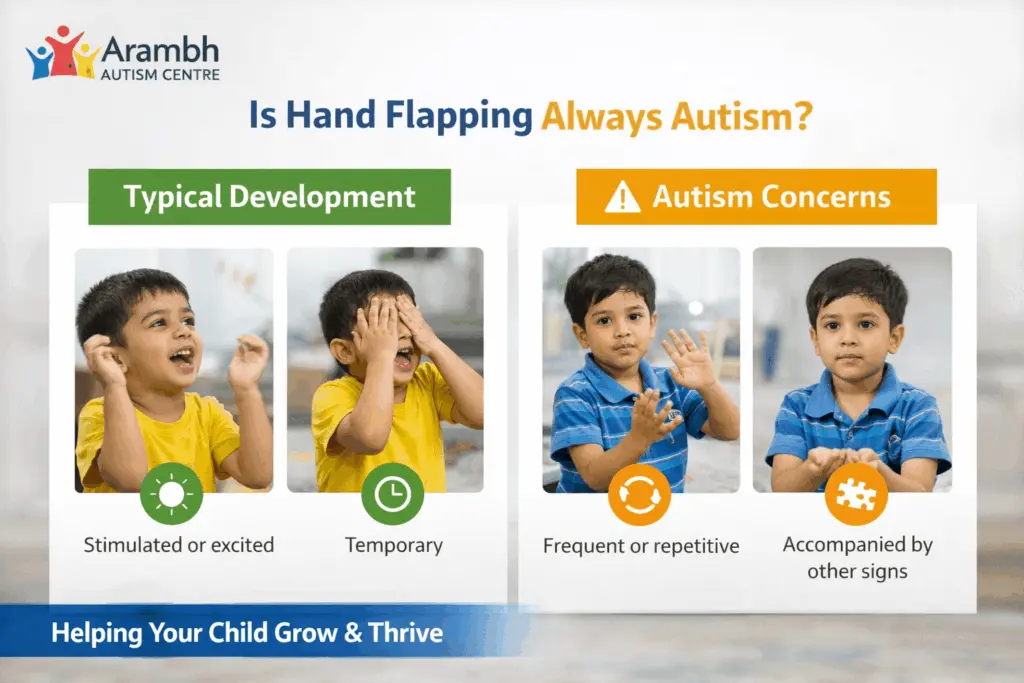
When Hand Flapping Is Completely Normal
In many children, hand flapping is just a phase.
You may notice:
-
It happens only sometimes
-
It reduces as the child grows
-
The child still talks, plays, and connects normally
For example:
A child sees bubbles → gets excited → flaps hands → smiles → moves on.
This is usually not a concern.
Because the child is still:
-
Making eye contact
-
Responding to name
-
Communicating
When You Should Start Noticing More Carefully
Now let’s talk about the part most parents miss.
Hand flapping becomes important when it comes with other signs.
Ask yourself:
Does your child also show these?
1. Limited Eye Contact
You try to connect…
But your child avoids looking at you.
Even during play or talking.
2. Not Responding to Their Name
You call them again and again…
But they don’t turn.
It feels like they are in their own world.
3. Delayed Speech or No Speech
Other children start speaking small words…
But your child:
-
Doesn’t speak
-
Or speaks very little
4. Prefers Being Alone
Your child plays alone most of the time.
Even when other kids are around.
5. Repetitive Behaviours
Along with hand flapping, you may notice:
-
Spinning objects
-
Repeating actions again and again
-
Watching the same thing repeatedly
The Important Truth Most Parents Don’t Hear
Hand flapping alone is not the issue.
It is the pattern around it.
If your child:
-
Connects well
-
Communicates
-
Responds
Then occasional hand flapping is usually okay.
But if multiple signs are present together…
That’s when you should not ignore it.
A Real Story That Changed Everything
Pooja Gupta noticed something similar in her daughter Pihu.
Pihu used to flap her hands often.
At first, it felt harmless.
Even cute.
But slowly, Pooja started seeing other things:
-
No response to name
-
No eye contact
-
No speech
Still, like many parents, she waited.
Hoping time would fix it.
But time didn’t.
When she finally took action…
She realized how important early support was.
That journey led her to create Arambh Autism Centre.
Not just as a professional…
But as a mother who understands exactly what parents feel.
Why Children Flap Their Hands
Let’s understand this simply.
Children may flap their hands because:
-
They feel too excited
-
They feel overwhelmed
-
They don’t know how to express emotions in words
-
It gives them comfort
In some children, it becomes a way to:
“Release feelings”
Like pressure going out.
Why Early Attention Matters
A child’s early years are very important.
This is when:
-
They learn fastest
-
Their brain develops quickly
-
Habits form easily
If a child needs support…
Starting early can make a big difference.
Not because something is “wrong”…
But because support helps them grow better.
What You Should Do As a Parent
If you notice hand flapping, don’t panic.
Just observe.
Ask yourself:
-
How often does it happen?
-
When does it happen?
-
Are there other signs?
Then take simple steps:
-
Talk to a child expert
-
Get proper guidance
-
Start early support if needed
Remember:
Taking action early is always better than waiting in confusion.
For Parents Who Are Feeling Worried Right Now
That feeling in your chest…
The doubt…
The fear…
It is real.
But it is also helpful.
Because it pushes you to notice.
And noticing is the first step toward helping your child.
A Simple Thought to Remember
Your child is not doing anything “wrong”.
They are just expressing in their own way.
Your role is to understand…
And guide them in the right direction.
Don’t Wait for “It Will Be Fine”
Many parents wait.
Months pass.
Sometimes years.
And later, they say:
“I wish I had acted earlier…”
You don’t have to be that parent.
Take the First Step Today
If your child shows hand flapping along with other signs…
Don’t ignore it.
Talk to someone who truly understands.
You can connect with Pooja Gupta, a mother who has walked this journey herself and now supports many families at Arambh Autism Centre.
📞 Contact: 9455920030
Sometimes, one conversation can bring clarity.
And clarity can change everything.
Final Words
Hand flapping is not something to fear.
But it is something to understand.
Because small signs…
When noticed early…
Can lead to big positive changes.
And your child deserves that chance.
Understand how we improve daily life skills.
Learn how daily skills can improve with the right support.
Learn everything parents should know about autism.